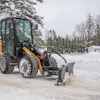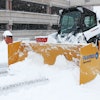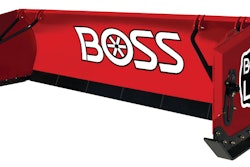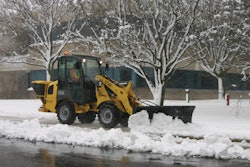
Box plows, also known as containment plows and snow pushers, are being utilized more and more by snow removal contractors. According to Gino Paonessa, president of Avalanche by Ledex Industries, the reason why comes down to one simple word: awareness.
Box plows are often associated with large wheel loaders clearing snow on massive properties. This is certainly the case, but not the only case where a box plow can be put to work.
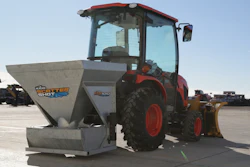
In addition to wheel loaders, box plows are also gaining popularity with the owners of tractor-loader-backhoes and even smaller skid steers. In fact, box plow sales for Avalanche are split pretty evenly between these three types of machines. It all comes down to: 1) what type of machine the contractor already has in his fleet, and 2) what type of properties he will be plowing in the winter.
Where They Work
“The wide-open space is the domain of the box plow,” says Mark Klossner, marketing manager with The Boss Snowplow. “Its mission in life is to quickly move large amounts of snow in a straight line.”
If a contractor services retail store parking lots, and already has a skid steer, tractor or loader to use, then a box plow should be considered. Not only can a contractor’s plowing efficiency increase, but he can also make his existing skid steer, tractor or loader pay him back 12 months out of the year, as opposed to just six.
Box plows are also frequently used at airport tarmacs, trucking facilities, distribution centers and large commercial buildings. But they can be effective in a smaller setting, too.
“We make 6- to 12-foot-wide box plows for small skid steers,” Paonessa points out. “This is an effective way to clear smaller parking lots that I believe will make a contractor much more productive than when using a pickup with blade.”
Why They Work
In addition to box plows, Avalanche also makes angled plows for road plowing. “This configuration makes sense when you’re plowing roads because you’re angling the snow toward the shoulder of the road,” Paonessa reminds. “But in a parking lot, you roll the snow away from a building or sidewalk, and create a ridge in the process. Then you turn around or back up, and continue pushing the snow away toward the perimeter of the lot. But with each pass the ridge gets bigger and bigger. Soon you have snow spilling over to where you just plowed. Going back to clean all of that up is inefficient.”
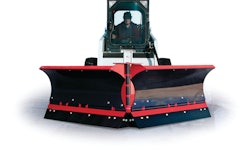
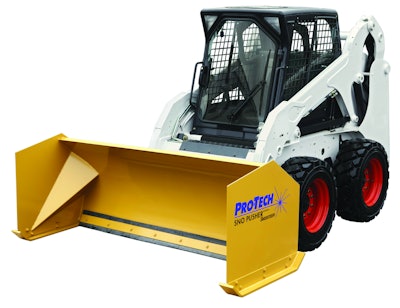
Box plows are designed to move snow by pushing it straight ahead. Sidewalls at either end of the plow help keep the snow contained. Paonessa says that with a box plow, you can collect three to five times more snow than a conventional plow before the snow starts spilling over.
Pro-Tech, manufacturer of the Sno Pusher, says that contractors can increase volume by as much as 500% when switching from a conventional blade to a box plow. According to snopusher.com, one Pro-Tech Sno Pusher will do the work of three or four trucks—in less time.
Then why doesn’t every snow contractor use this approach? “One reason is mobility,” Klossner says. “Box plows are more difficult to transport from site to site because of their size. You simply cannot drive down the road with a loader or skid steer that has a box plow attached. They’re too wide, and for multiple legal reasons, it just doesn’t work. That mobility, as well as maneuverability, are what still make the pickup truck-mounted plow an indispensable tool in the professional snow remover’s arsenal.”
Cutting Edge
When and if you decide that a box plow is in your future, you’ll then want to figure out what kind of cutting edge is best for you. There are two types, rubber and steel, each of which has its own pros and cons.
RUBBER BLADE – “When temperatures typically hover just above freezing and snow is slushy, a rubber edge will work just fine 90% of the time,” Paonessa points out.
Pros: Provides a squeegee-like effect / gentle on delicate surfaces
Cons: Areas of harder, packed snow could be left behind
STEEL BLADE – “Way up north where it gets really cold, like up here in Canada, a rubber blade might not be efficient,” Paonessa says. “This is also true in places where it warms up a bit during the day, then the snow starts to melt, only to freeze again at night when it gets much colder.”
Pros: Scrapes ice and hard-packed snow from the pavement / less likely to break if you hit something, as long as it’s well-built and has a sufficient spring-trip mechanism in place)
Cons: More expensive upfront, though gains in productivity and customer satisfaction will often make up for that
Pro-Tech recently introduced the Switchblade Sno Pusher, which provides for the ability to alternate between a rubber edge and steel trip edge. The company says that switching from one side to the other takes less than a minute. A total of 12 Switchblade models are available.
Other Performance Features to Look for
Matthew Price of Avalanche says that contractors should be concerned primarily with two things: performance and build quality. Let’s start with where we left off: the cutting edge.
“Look at the compound of the rubber used,” Price advises. “Determine what the durometer rating is, which indicates the density and probable longevity of the rubber. Durometer ratings vary across manufacturers from a low of under 60 all the way up to 85.”
On a steel trip edge, how well is the trip system engineered? “Is it a true trip mechanism with torsion springs, or simply a steel blade riding on the existing rubber blade?” Price asks.
For construction of the plow itself, what grade of steel is used? How are the side panels braced? “This is the area most prone to failure because the side panels are what get hit most frequently,” Price points out. Are they braced with a single strut or wedge piece, or are they double-braced?
The receiver where the plow connects to the machine is another critical area. Is it made from solid steel plate, or hollow box tubing? “Receiver construction is going to have a big effect on the longevity of the unit,” Price says.
Finally, the warranty is an important consideration, as is cost. But be careful about that one. “Consider the total cost of ownership,” Price advises. “That includes the probable length of service life. It is better to pay 10% more for a plow that is going to last 50% longer,” he says. “As with all things in life, you get what you pay for.”