As David Spector’s company has grown over the past 12 years, he’s recognized that what worked as a new, small company still works as a seasoned, large company. Passion, education and attention to detail built a solid reputation. But when the recession started to take shape a couple of years ago, one thing had to drastically change.
“We needed to diversify,” says Spector, co-owner of TLC - The Landscape Company in Mesa, AZ. Actually, TLC was quite diversified already; the company had been offering commercial maintenance and enhancement services, lawn care, irrigation maintenance, auditing and design for years. But when the recession hit in 2008, and property managers started seeing their budgets squeezed, Spector wanted even more to offer.
From Dabbling to Dedicated
“We launched a tree care division in 2009,” Spector tells. TLC had long been offering basic tree care services to existing clients, but the Spectors wanted to commit to a dedicated division that was fully equipped and staffed, and aggressively marketed. He sat with wife Bridget and son Louis to discuss the plan. Bridget is a partner and TLC’s controller. Holding a master’s degree in accounting, she mapped out investment needs and revenue goals. Comfortable with their business plan, all three Spectors got their international arborists certifications—and forged ahead.
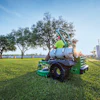
“We bought a Toyota Hino dump truck, which we had customized to meet the needs of our tree care division,” Spector says. “The truck was purchased as a cab and chassis only. We had the frame cut and the box custom built. We do all of our trees by climbing and rigging. We need lots of gear to support this type of working style. So our truck has lots of boxes, holders, doors and drawers, and even a slide-out work table used for field dressing chains and cleaning air filters.”
TLC already owned Stihl chainsaws and a Vermeer chipper. As for the customization of the truck, Spector hired the same nearby machine shop that fabricates all of TLC’s maintenance division trailers, which Spector has designed himself (see video at GreenIndustryPros.com/video; click on Trucks & Trailers).
TLC also created marketing materials and added an “arbor division” section to its website. No longer would tree care services only be provided upon existing customer request.
Louis, the company’s operations manager, then asked existing employees for volunteers to move over to the tree division. After tryouts and training, they were off and running.
Soon a key staff addition was made—even though it wasn’t in the Spector’s original plans for this new division. “Our tree crew was out working one day when a guy pulled up in a pickup,” Spector recalls. “He walked up and asked if we were hiring. I said, ‘No, not really.’ The guy asked if he could grab his tools out of his truck and show us how it’s done; he said he could climb and prune three palm trees in a third the time it was taking us. I said, ‘Sure, I gotta’ see this.’
“He was like Spiderman,” Spector continues. “Sure enough, he climbed up one tree, did his saw work, swung over to the next tree and took care of that one, then swung onto the third tree, completed that tree, swung back to the original tree and repelled down. In 10 or 15 minutes he was back on the ground. I said, ‘On second thought, we’re hiring.’ Turns out that he’s an ISA-certified climber.” (TLC has since hired an additional certified climber.)
Inventorying and tracking is a primary tool of TLC’s tree care management program. “We document the location with our GPS (Global Positioning System), so species and other relevant information of each tree is tracked,” Spector says. “We can also tag the trees so that each is specifically identified for ease of verification and tracking both in the office and in the field. The data is added to a database and plotted using sophisticated GIS (Geographic Information System) software that can layer information on top of an aerial photograph or other community maps. The data can be filtered in any number of ways to show individual species of tree, storm damaged trees, trees near home, etc.” This system also works well for all assets on the property that benefit from a mapping and tracking system.
If It’s Not Perfect, Make It Perfect
Without a doubt, TLC was no longer just dabbling in tree care—they were dedicated to it. The company is also dedicated to perfection.
Blessed with a green thumb and an inventor’s mind, Spector is always on the lookout for ways to improve systems, equipment and training. In addition to the company’s custom-designed tree truck and maintenance trailers, Spector also invented a locking irrigation valve box lid to prevent vandalism and cut down on wasted water (see “So Brilliant it Needed a Patent” below).
In the maintenance/lawn care division, Spector custom-blends his fertilizers, using a local manufacturer. “When we take on a new property, we immediately take a soil sample to determine the exact needs of the soil,” Spector tells. “For properties we’ve been maintaining, we’ll take subsequent soil samples when we start to see areas of stress.”
Back at the office, Louis the operations manager has devised a system whereby maps of TLC’s largest properties are hung on a wall in the training room. Louis color-codes the maps to show the most efficient mowing patterns, along with which mowers will be the most productive in certain circumstances. “This has helped us reduce our mowing man-hours by a third on some properties,” Spector points out.
Saving money without negatively impacting results is what it’s all about these days. After 12 years in business, TLC certainly has things dialed in.
So Brilliant It Needed a Patent - Locking Access Device (LAD) helps reduce wasted water.
Wasted water from irrigation systems is something that can be prevented, and one Arizona contractor has taken matters into his own hands.
David Spector of Mesa-based TLC - The Landscape Company has been working in the Arizona landscape arena for 36 years. He has had to deal with the issue of wasted water due to the lack of positively locking valve box lids, not to mention the propensity for vandalism and overzealous people trying to turn on the watering systems. Both reasons add up to irrigation systems left running—and wasting water.
“I tried the bolts that the manufacturing companies provide,” Spector relates. “I tried screwing the lids to the boxes. I tried metal straps with pad locks. Nothing would keep someone who was intent on accessing the valves from opening the lids to do their dirty work. So I had to come up with something that would work.”
After several years of development, Spector came up with a simple, sustainable and cost-effective locking mechanism. A set of bars that fit under or into the support frame for the lid eliminate unwanted access. These lids can be retrofit to any box, which means you don’t have to dig up the box in order to make this work.
“No one has gained access to any of these secured boxes since we have been selling them to the public,” Spector points out. Putting the Locking Access Device (LAD) on the boxes will keep the systems safe. Reduced costs for repairs and wasted water pay for the LAD many times over.”
TLC - The Landscape Company in Mesa, AZ
Owners: David and Bridget Spector
Year Founded: 1998
Estimated Annual Sales: $2 million
Business Mix: 71% all-inclusive maintenance contracts that comprise mowing, irrigation, chemicals and tree care; additional revenue derived from 9% tree care, 8% irrigation, 12% “other” including landscape enhancements, chemical/fertilizer, design and consulting services
Employees: 42 all year, 50 peak season