What do you get when you cross a seasoned landscape contractor and an experienced property manager? A professional landscape management company that has more than doubled in size over the past four years.
Kevin Robinson and Matthew Johnson joined forces in August 2005 to form the new Asset Landscaping in Phoenix, AZ. As a landscape contractor, Kevin knew Matthew, a property manager, for several years. Kevin’s brother Keith rounds out the management team as the company’s controller. Dave Londen and Matt Whitson serve as customer service managers.
This trio has a lot to control these days. Sales have grown 20-25% annually to a current level of $3.6 million. The number of maintenance crews has tripled (12 year round, 14 peak season). Despite the downturned economy, the new partners have remained focused on their objectives:
- Recommit to investing in the company
- Re-establish a high level of pride among employees
- Become the premier maintenance contractor for homeowner associations (HOAs).
Step 1 – The first thing Kevin and Matthew did when taking over the company was invest in eight new trucks. New equipment investments soon followed. “Guys will not take pride in what they do if you give them broken-down equipment,” Kevin relates. One of Kevin’s frustrations with his previous partners was their lack of desire to invest in the company.
Step 2 – A detailed training and safety program was put in place. In the case of standard personnel, each employee is given the following safety information and instruction as soon as they are hired and e-verified:
- Safety manual
- Safety videos
- Training conducted by foreman, reviews overseen by supervisor
- Weekly in-house safety and training meetings
- Annual safety and training workshop conducted on-site
In the case of drivers:
- License verification happens immediately upon hire, and then annually through the insurance company. Motor Vehicle Registration reports are verified intermittently.
- Driver safety test is completed online.
- When a vehicle or injury incident happens, any medical issues are handled immediately. An incident report is then completed and reviewed. Additional training follows, such as safety video reviews and driver training and/or re-testing.
Step 3 – A balance score card was drafted to help management measure company performance. The score card includes items that dramatically affect a company’s financial health, yet aren’t included on a profit and loss statement.
Customers
- Growth goal for the month (for example, “pick up two new commercial customers this month”)
- Account turnover
- Top 2 customers – Asset Landscaping doesn’t want their top two accounts to represent more than 40% of total revenue; that way a lost account will not break the company
- HOA growth – since this is the company’s bread and butter, management wants to keep close tabs on trends in this area
- Kill ratio (bids earned/bids submitted)
Employees
- Driving incidents – includes accidents, customer complaints for careless driving, etc.
- Employee turnover
- Injuries
Financials
- Revenue
- Gross margin
- Net profit
- Cash reserves
- Debt reduction
Internal Processes
- Labor costs (are we staying within budget without degrading quality?)
- Customer complaints
- Service requests
A key objective of the balance score card is to attain buy-in from all employees. “Everybody in the company knows their goals,” states Keith the controller. Management meets with the company’s two account reps and three supervisors twice each month to review progress. Supervisors then disseminate information to their foremen and crews.
Step 4 – Tuesday staff meetings also keep everybody up to date on how the company is doing. The meetings include timely safety tips, along with what Kevin refers to as “atta boy” moments.
“When we have a customer call to say how pleased he or she is with our work, we recognize the crew at our Tuesday morning meeting,” Kevin says. “We give the foreman a certificate, along with a cash bonus to take his guys out to lunch.” To be fair to those crews servicing customers who aren’t so inclined to call in with praise, account reps and management can also recognize outstanding crew performance. In other words: Hard work does not go unnoticed at Asset Landscaping.
“You have to set your people up to succeed, inspecting what you expect along the way,” Kevin says. “Employee goals and rewards then have to be tangible if you expect employees to help you reach your overall company goals,” Matthew adds.
Targeting a New Clientele
Prior to joining forces with Matthew in 2005, Kevin and his former partners serviced a lot of apartment complexes. Now, given Matthew’s background as a property manager, Asset Landscaping focuses on the HOA market. “I spent the first year out hustling for business with Matthew attached to my hip,” Kevin recalls. “To get up to speed on the landscape business, I also spent a lot of my time reading, and talking with our supervisors and foremen,” Matthew adds.
Instant Communication, Ongoing Education
With reliable equipment, employees and supervisors firmly in place, the Asset Landscaping management team has been able to direct the majority of its attention to sales and service. “Our objective is to provide customer service, education and communication that is leading edge,” Matthew points out.
Matthew regularly entertains clients and attends HOA board meetings. Asset's two customer service managers also help develop rock-solid relationships with property managers. In addition, Asset Landscaping is involved with several area property manager associations.
An e-newsletter helps educate customers on topics such as water conservation and the importance of proper shrub maintenance. This one-page PDF is emailed monthly to Asset Landscaping’s customer list. Matthew says this once-a-month frequency is ideal.
When customers have concerns or if problems arise in the field, a response time of literally minutes is ideal—and is made possible by a structured mobile messaging system. Here’s an example of how it works:
- A property manager calls the Asset Landscaping office to say he or she has a downed branch
- The admin person who took the call sends an email to all employees with an Asset Landscaping email account
- Management, customer service managers and supervisors all have BlackBerries, so anyone can read the message and respond to it immediately
- Supervisor #1 has a crew in the vicinity of the property … he replies-to-all that one of his crews can stop by to clean up the branch
- Supervisor #1 then calls his foreman (all foremen have company-paid cell phones) to give him instructions on cleaning up the branch
- Either the customer service manager or admin staffer who took the initial call from the customer calls that customer back to inform him or her that the situation is under control
“It’s a microwave world, and people want it now,” Kevin reminds. Asset Landscaping’s quick response time can mean the difference between customer retention and customer attrition.
Education is also increasingly important. Asset Landscaping likes to develop three- to five-year plans for its HOAs. During tough times, you sometimes have to deviate from those plans. “The trick is getting the property manager back on the plan as quickly as possible,” Kevin points out.
These days, Kevin and Matthew agree that property managers are still feeling some pain, but things are getting better. For instance, where $4,000 in badly needed irrigation repairs were put off last year, a property manager is willing to spend $500 or $1,000 this year to keep the problem from getting out of hand.
“Those who flat out refuse to do anything probably won’t be our customers for very long, and that’s OK,” Matthew says. Asset Landscaping is in the business of “enhancing your environment” (so their slogan states). And as Kevin reminds, “These are just mowers, not magic wands.”
A proactive approach to property management and client communication has helped this Phoenix company more than double in size over the past four years. That doesn’t happen by accident. That happens when you have a plan. Asset Landscaping has a plan—and it’s working.
Landscaping for an NFC Powerhouse
Asset Landscaping’s specialty is HOAs, yet 10% of its revenue comes from a variety of other commercial clientele, including health care facilities, hotels, industrial parks, and the NFL’s Arizona Cardinals.
Since 2001, Asset Landscaping has provided landscaping services for the Cardinals. Today the company installs plants and performs irrigation system maintenance throughout the University of Phoenix Stadium’s exterior. In addition, Asset Landscaping provides landscape installation and maintenance services throughout the exterior of the Cardinals’ practice facility.
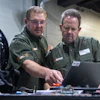
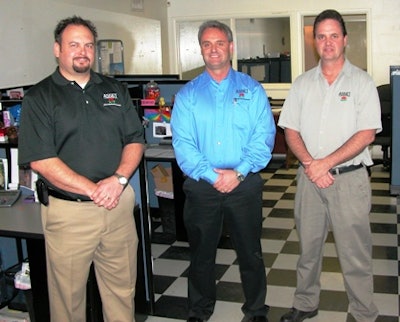
Pictured left to right (photo 2) are Asset Landscaping co-owner Matthew Johnson, customer service manager Dave Londen, and Arizona Cardinals turf specialist Andy Levy.
Asset Landscaping in Phoenix, AZ
Owners: Kevin Robinson and Matthew Johnson
Year Founded: 1995
Annual Sales: $3.6 million
Business Mix: 90% HOA maintenance, lawn care, enhancements and irrigation; 10% commercial maintenance and lawn care
Employees: 80
Maintenance Equipment: Exmark, Hustler and Grasshopper zero-turns; Exmark, Honda and Husqvarna push mowers; Maruyama line trimmers, hedgetrimmers and backpack blowers; Stihl chainsaws and pole pruners; Little Wonder lawn vac
Lawn Care Equipment: Shindaiwa backpack sprayers; Spiker spreaders; SpreadEx broadcast spreader on Club Car cart
Irrigation Equipment: Case trencher; Ground Hog auger
Truck Fleet: Isuzu NPR box trucks; Mitsubishi Fuso box trucks; Ford F-250s