Although each area of a dealership serves a different purpose and functions in a unique way, leading dealers are finding methods to create accountability among all of their employees.
A large part of creating accountability is rewarding good performance. Tom Rigg of Rigg’s Mowers & More, a four-location dealership headquartered in Valparaiso, IN, says it best: “Whether you’re a salesman, parts person or technician, I think everybody needs a goal.”
Sales Department
At Rigg’s Mowers & More, equipment sales reps earn a commission on everything they sell, in addition to a base salary. And if they perform well according to their original sales budget, additional incentives are in place.
“Our salesmen are given goals at the beginning of each month,” Rigg says. “When they reach their first goal, they are given two percent of what they’ve sold. When they reach their second goal, they earn another two percent. The third goal is based on the profit derived from their sales. This is really important because it keeps guys from cutting prices.”
It’s also important that each sales rep is aware of everyone else’s goals—and whether or not goals are being met. It creates healthy competition between reps, not to mention stores.
“Every month we offer another cash bonus for the store that has the most sales,” Rigg says. “Instead of cash we sometimes offer up a manufacturer-supplied spiff or the opportunity to attend a sales training event, for example.”
Things get tricky from time to time, Rigg points out. “It’s not often, but every once in a while we’ll find that customers are price shopping between our four stores,” Rigg tells. Communication and the bonus based on profit help keep this in check.
Service Department
Generally speaking, your technicians must bill at least 50% of their total hours if you want your service department to make a profit. In Tupelo, MS, dealer Russ Harrington of 4 Seasons Equipment wants his service department to be highly profitable, which is why he incents technicians to bill at least 80% of their hours.
Each of the dealership’s four full-time technicians earns a base salary. Then, each obtains a monthly bonus based on the amount they produce that month. “It’s very simple: The more hours they bill, the more money they make,” Harrington says.
“More money” definitely talks, but is not the only secret to building accountability in the service department. Harrington invests in tools and training so his staff remains equipped and inspired to perform.
“Every technician attends service schools,” Harrington points out. “We try to make every one within a couple hundred miles. We also sent two of our techs to the STIHL factory in Virginia Beach to become STIHL Gold-certified.”
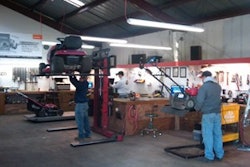
With respect to tools and equipment, every technician has his own lift table. The shop also has a Heftee lift, which sometimes becomes an issue when more than one tech needs to use it at the same time. “We plan to invest in a second lift once business improves a bit more,” Harrington says.
The shop has also invested in a laptop computer and software program from Kohler so techs can work on Kohler EFI engines. A STIHL specialty tool set is also the property of the shop. Technicians are expected to furnish their own basic hand tools.
Parts Department
Some might refer to parts department employees as the unsung heroes in an equipment dealership. Although parts sales play a significant role in a dealership’s overall profitability, parts staff are often left on their own to sort, stock and search, and occasionally deal with that unruly customer. How can you recognize and reward these critical members of your frontline force?
“The occasional pat on the back can go a long, long way,” says Ernie Buttita of K&D Rent-All & Hardware in Baton Rouge, LA. “Then again, nothing is as rewarding as more money!”
Up in Benton, IL, F.B. McAfoos & Company has instituted incentives based on parts department profitability. This has helped keep individual employees honest, and the entire team of employees working together—which would not be the case if incentives were based purely on sales.
F.B. McAfoos recently hired its fourth full-time parts person. Two of the other three have been with the dealership for six and eight years; they handle most of the management duties, in addition to ordering and sales. One does the bulk of the dollar sales volume—wherein lies the problem.
“The guys doing the receiving and dealing with all those small-dollar parts are just as important to the department’s success,” McAfoos points out. “Furthermore, controlling expenses, charging out freight and keeping inventory accurate are all important functions that can be overlooked if you only focus on sales volume.
“We do departmentalized accounting, so it’s been fairly simple to put an incentive program together that’s based on monthly net operating profit,” McAfoos continues. “We always discuss asset management and margins each month before I pass out the checks. We’re still making adjustments as we go along, but this program keeps all employees involved in everything—and that makes the department profitable.”
Poor performance results in no incentive. Fortunately, the “departmental profit” basis of the program keeps parts staff policing each other. “If we were to have an employee who wasn’t carrying his weight, the others have a vested interest in correcting the situation,” McAfoos says. “Since all sink or swim together, there is plenty of reason for each of them to want the others to succeed.”
A Checklist to Creating Accountability
- Establish clear goals and expectations – Always set standards for performance, and put policies and procedures in place.
- Make sure you’ve got accountability leaders within the organization. These will be those managers who challenge the drive and performance of other employees and measure the results.
- Transparent, honest communication enables people to provide feedback about their performance and limit the opportunity to hedge around an issue.
- Develop and implement a follow-up system of accountability, which allows for regular meetings that measure and track performance, productivity and results.
- Focus on the vital few instead of the trivial many when setting company goals. Do the same for individual goals set by each employee.
- Put the proper rewards and recognition in place. These don’t always have to be monetary in nature. Verbal praise, both in the private and public setting, is highly appreciated and motivating.
- Define ownership of each new process and procedure you establish.
- Develop the leadership pipeline. Accountability starts at the top of the organization and works itself down. Owners and managers must strive to perfect their own leadership skills and accountability before expecting others within the organization to do the same.