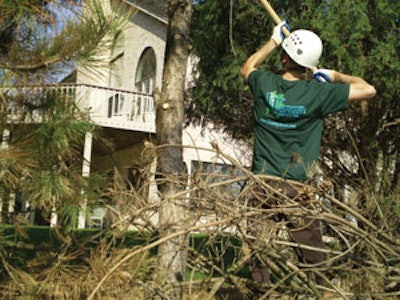
A tree care worker was standing on a ladder using an extended aluminum pole pruner to trim a palm tree. The pole pruner came into contact with an energized power line. The worker was electrocuted.
In another incident, a crew member was in an aerial lift truck using a hydraulic pruner when he came into contact with electrical lines, causing a severe electric arc flash across his chin and neck. The worker, whose clothing and flesh burned, fell unconscious into the elevated bucket. Co-workers promptly lowered the bucket and poured water on him, but repeated attempts at cardiopulmonary resuscitation (CPR) failed to revive him.
These are just two of many examples of electrical-related deaths within the landscape services industry. According to the National Institute for Occupational Safety and Health (NIOSH), employees in this industry are more likely to die from electrocutions (9.8% of their job-related fatalities from 2003-2006) than those in the U.S. workforce overall (4.4% of the job-related deaths during that same period).
Performing tree care work is not the only way employees in our industry may come into contact with potentially deadly electrical current. Other ways include failing to determine the location of underground utilities before digging, digging in areas where underground utilities were incorrectly marked, using an aluminum ladder near overhead power lines, getting too close to power lines with cranes and other equipment, and not regularly inspecting the condition of power tools, breakers, wires and other electrical connections.
“If someone comes into contact with a (live) wire, the person is usually killed,” says Scott Jamieson, vice president for corporate partnerships and national recruiting at Bartlett Tree Experts in Northbrook, IL. Jamieson, who is also a Tree Care Industry Association (TCIA) board member, adds, “Often the wire is not seen. This typically happens in residential areas. Someone trimming the tree doesn’t see the wire.”
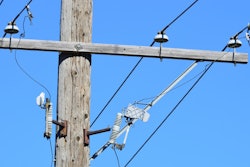
What often occurs, Jamieson says, is that a branch saw or pruning pole comes into contact with the overhead wire. “The person may also come into direct contact with the wire. Or, a crane or hand tool touches the wire and the person is electrocuted that way,” he says. Another “killer” when working near overhead power lines, Jamieson adds, is an aluminum ladder. “Most tree professionals use fiberglass,” he notes.
Laurie Erdman, safety manager at The Bruce Company of Wisconsin, says it’s important for landscape contractors to call 811 or their local one-call center before digging to determine the location of all underground utilities. Incorrectly marked underground utilities can cause a problem, she says, as can instances where the utilities aren’t burying their lines deep enough.
Tips to reduce your risk
Both Jamieson and Erdman, who chairs the Professional Landcare Network’s (PLANET) Safety & Risk Management Committee, say that the responsibility for electrical safety lies with the employer, the salesperson who lands your company the job, and your workers.
Employer responsibilities
Require crew leaders or other supervisors to assess each jobsite for potential hazards. Crew leaders should also perform safety inspections of all equipment, tools, vehicles and personal protective equipment (PPE) that is being used before work begins.
Providing the appropriate PPE. In a document entitled “Overhead Power Line Safety Tips for the Construction Industry”, OSHA notes that PPE must be appropriate for the job that is performed, and may consist of such items as rubber insulating gloves, hoods, sleeves, matting, blankets, etc. NOTE: It’s also critical to provide both fall protection and head protection when working from heights.
Knowing what else OSHA requires. One of the most important standards is OSHA’s “10 foot rule,” Jamieson says. “Unless you’re a qualified line clearance tree trimmer, you should remain 10 feet away (from overhead power lines). This is often violated, but is the safest thing to do. Also, make sure that the wire is 10 feet away from the pole pruner or furthest tool you are holding.”
Training all employees who work around electricity. This includes shop supervisors who use power equipment and hand tools. “Remember that water (on a shop floor) is a conductor of electricity,” Erdman says. “There needs to be enough clearance so they’re not knocking into indoor electrical lines. Also, if they are working in a shop where there are a lot of electrical tools, rubber soles and proper footwear are important.”
Salesperson responsibilities
Call 811 at the start of the job and check the site to see if there are any overhead or underground wires. “If a general contractor is on site, that company will probably have the underground utilities marked. But the people actually doing the job should also have their own ticket number markings,” Erdman says. (See “Safety Resources” on this page for more information.)
“Training must start with the salesperson,” Jamieson believes. “The number one thing on that person’s safety list should be if there are any electrical wires. If any are noted, it should be put on the work order and the job specifications.”
Training your workers
It’s critical to ensure that your workers are adequately trained to work around electricity. The following are some tips you can share with your employees.
• Conduct initial and daily surveys of your worksite and address any hazards or potential hazards that are found.
• Don’t operate equipment around overhead power lines unless you are authorized and trained to.
• Unless you are a qualified line clearance tree trimmer, always remain at least 10 feet away from overhead power lines. That includes ensuring that any equipment or tools you are using also remain 10 feet away.
• If a crane or other equipment being used comes into contact with a power line, stay away from the equipment and do not let anyone else touch it.
• Use a non-conductive wooden or fiberglass ladder when working near overhead power lines. Know that aluminum ladders and metal scaffolds or frames conduct electricity.
• Never touch a person who is in contact with a live power line. Call for emergency medical assistance.
• Never touch a downed power line. Assume that it is energized.
• Always check the location of underground utilities before you start digging at a job site. Make sure underground utilities are marked. NOTE: The Utility Location & Coordination Council Uniform Color Code will help you identify the different types of underground utilities. For example, “red” signifies the location of electrical power lines, cables, conduit and lighting cables. (See photo at right.)
• Stay away from water when working near electricity.
• Regularly inspect the condition of power tools, cords, wires, breakers and other electrical connections. Inspect the condition of outlets to make sure they are not overloaded. Never remove the third plug of a three-pronged plug which is used to ground electrical equipment.
• Always use appropriate PPE.
Safety Resources
Numerous resources are available to help you train your workers in electrical safety. These include:
• Your local utility company. If your workers are regularly exposed to electricity, ask if your local utility has a staff person who will come to your company to provide training and demonstrations.
• The 811 website includes information on the various states’ notification requirements governing digging. NOTE: Some states’ rules are stricter than others.
• National Institute for Occupational Safety and Health (NIOSH). NIOSH’s many resources include: “Fatal Injuries Among Landscape Services Workers” (NIOSH Publication No. 2008-144), (English) or (Spanish) and NIOSH’s Safety and Health Topic web page: Electricity. This web page includes links to many additional NIOSH documents including “Workplace Solutions: Preventing Worker Deaths and Injuries from Contacting Overhead Power Lines,” “NIOSH Alert: Request for Assistance in Preventing Falls and Electrocutions During Tree Trimming,” and “NIOSH Alert: Request for Assistance in Preventing Electrocutions of Workers Using Portable Metal Ladders Near Overhead Power Lines.”
• NIOSH’s Fatality Assessment and Control Evaluation (FACE) Program. www.cdc.gov/niosh/face, includes reports from investigations of many electrical-related fatalities.
• Occupational Safety and Health Administration (OSHA). OSHA’s Safety and Health Topic Page: Electrical, includes information on which OSHA standards apply, how to recognize electrical hazards, and potential solutions. The web page also provides links to various other OSHA documents. One document, “Overhead Power Lines – Don’t Get Zapped!,” is an employer kit designed to reduce electrocutions involving contact with overhead power lines.
• Tree Care Industry Association (TCIA). TCIA’s (www.tcia.org) Electrical Hazards Awareness Program (EHAP) trains tree care professionals to recognize and avoid electrical hazards and helps employers meet applicable OSHA requirements.



![Optimax Sp 0228[1]](https://img.greenindustrypros.com/mindful/acbm/workspaces/default/uploads/2026/05/optimax-sp-02281.lJdm8xL6hQ.jpg?auto=format%2Ccompress&fit=crop&h=100&q=70&w=100)




![Optimax Sp 0228[1]](https://img.greenindustrypros.com/mindful/acbm/workspaces/default/uploads/2026/05/optimax-sp-02281.lJdm8xL6hQ.jpg?ar=16%3A9&auto=format%2Ccompress&dpr=2&fit=crop&h=135&q=70&w=240)


