
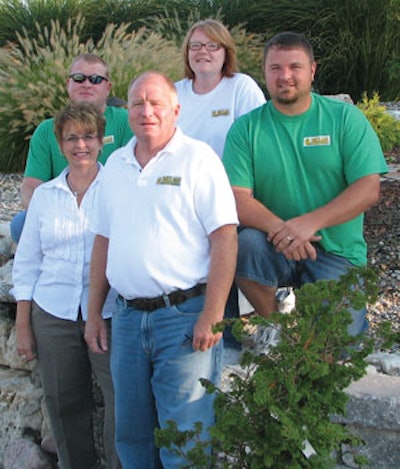
With construction spending down, a lot of landscape contractors have been focusing more on their maintenance divisions. Dinkelman Landscaping in Carlyle, IL, is no exception. But their story is a little bit different. Rather than just mowing more lawns, they’re knocking down trees and maintaining easements for pipeline and utility companies.
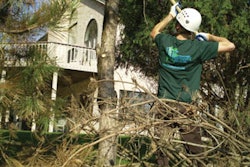
“We typically maintain a 50-foot easement—25 feet on either side of the pipeline,” says owner Terry Dinkelman Sr. “This right-of-way maintenance service requires mowing, removing trees and grinding out stumps, and sometimes replanting the area with biological deer plot mix or maybe a pasture grass so the easement looks better, is easier to maintain and is eco-friendly.”
Dinkelman Landscaping has also begun doing power line right-of-way clearing for utility companies. “It’s not a big part of our business just yet, but the ice storms that swept through Kentucky and the Northeast this past January have people thinking more about safety when it comes to tree limbs and electrical lines,” Terry Sr. says. “We have every reason to believe this business will grow for us.”
GETTING THE RIGHT-OF-WAY
Pipeline right-of-way maintenance has already been growing for the past four years, and today accounts for 65% of Dinkelman Landscaping’s total sales. Terry Dinkelman Jr., who manages the company’s right-of-way division, is confident this positive trend will continue.
“The population keeps growing, and people are always going to need fuel,” Terry Jr. says. “Also, with stricter regulations and an increased focus on disaster planning, the government needs these pipeline easements cleared out and maintained.”
Terry Sr. understands that concept all too well. He actually worked for a pipeline company for several years while also doing some landscaping on the side. “Mowing yards and doing some smaller installations helped put the kids through college,” he relates. “I even had one really big job where I put in a baseball field for a local junior high school, including the irrigation system.”
That project helped elevate Terry Sr.’s profile as an area landscaper. By late-2000 he decided it was time to make landscaping his full-time career—and Dinkelman Landscaping was incorporated.
The Dinkelmans continued doing lawn maintenance, flower and tree installations and a bit of lawn care for the next few years. They also branched into hardscaping and water features. Then, like most landscapers experience at some point in their evolution, the Dinkelmans’ big defining moment came in 2005.
“A friend of mine from a local pipeline company asked me if I’d ever thought about getting into right-of-way maintenance,” Terry Sr. recalls. “Since I’d worked for a pipeline company for several years, I had a pretty good feel for what their needs were. They were looking for another contractor, and that’s basically how it all started.”
It was a huge step to take, but fortunately Dinkelman Landscaping had a lot of the equipment it would need to take it. Much of the right-of-way work is handled with a Bobcat compact track loader, which was already in the company’s equipment fleet. Various Bobcat work tools are also utilized, including a brush mower, stump grinder, soil conditioner and grapple.
Several new investments did have to be made. “The first thing we needed was a bucket truck,” Terry Sr. points out. “We also had to buy a couple Kershaw tree trimmers, several brush chippers, and a heavy-duty Fecon brush mower. But a lot of the work is still handled with our compact track loaders, which are great because they can work on wet turf, which we often have to do.”
RISKY BUSINESS
The right-of-way maintenance business is a very demanding one—for good reason. “It’s mandated by the government that these pipeline easements be either inspected by air or walked on a weekly basis,” Terry Sr. explains.
“It’s a proven fact that most of the damage to pipelines is caused by third parties. For example, let’s say a property owner is digging a swimming pool and hits the pipe with a tooth bucket. It might not burst the pipe right then and there, but it could cause some serious damage that creates a problem, maybe even an explosion, down the road. That’s why it’s in the public’s best interest to keep these pipelines clear.”
And that’s why the key to retaining this business comes down to one simple word: safety. “Safety is by far the biggest issue,” says daughter Mary Huston. “That one moment when you’re not being safe could cost you everything.” “Our pipeline customers demand zero accidents,” Terry Sr. adds. “We are definitely in a high-risk business.”
But the Dinkelmans knew they would be when they made the foray into right-of-way maintenance back in 2005. “I knew I had to immediately bring my employees up to ‘operator certification standards,’” Terry Sr. tells. “That means they’re recognizing pipeline hazards and understand how to place markers.”
Dinkelman employees also had to go through significant DOT certification training. Furthermore, the company had to write its own safety program and submit it to the pipeline companies in order to be awarded a contract. Once awarded a contract and out on a jobsite, an employee had better never get caught without his personal protective equipment (PPE) in place—including fire-retardant clothing and a hardhat.
Getting employees into a “safety first” frame of mind wasn’t all that difficult, Terry Sr. says, but keeping them there takes a lot of repetitive training. “We have safety meetings every single day. We show safety videos from the equipment manufacturers, and things of that nature. Safety is the most important thing in this business.”
Quality work is an extremely close second. “The right-of-way business is very price-competitive,” Huston says. “You got a bunch of different contractors chasing the contracts,” Terry Jr. adds, “but in the end it really comes down to quality.”
That’s exactly why Dinkelman Landscaping, although much smaller than many of the right-of-way maintenance companies out there, has been able to secure such a foothold in this market. While Dinkelman’s right-of-way division was launched on a single contract with a single pipeline company back in 2005, the company’s quality work fueled that precious word of mouth—and several more contracts with other pipeline companies soon followed. “Today we’re booked about a year ahead, and already have several bids out for 2010,” Terry Jr. points out.
EXPANDING LANDSCAPE
The backlog of work in the company’s landscaping division is fairly deep itself. “Even though landscaping only accounts for a third of our total business, sales are considerably higher than they were a few years ago,” says son Shawn Watts, who heads up the landscaping division. “In fact, our landscaping business grew 30% in 2008 alone.”
The right-of-way division has helped spur some of that growth, as some property owners ask Dinkelman Landscaping to come back and perform restorations. For example, the easement maintenance contract may require some trees to be taken out, so the property owner asks Dinkelman to replace them with flower beds, stonework or fencing.
Speaking of property owners, that’s been another challenge Dinkelman and crew have learned to overcome. “If you’re a property owner with a pipeline running through your yard, and some contractor comes up and tells you that three of your trees have to go, you’d be pretty mad,” Terry Sr. relates. “That said, we’ve become pretty good at dealing with customers.”
With respect to landscape maintenance, most of Dinkelman Landscaping’s customers have been with them since the beginning. Watts says they haven’t really tried to grow their landscape maintenance customer base.
“We want to keep it pretty simple—focusing on those accounts that are willing to pay for our high-quality work,” Watts explains. “There are plenty of maintenance contractors around here, so we don’t want to go chasing after every single property. Most of our long-standing accounts want much more than just mowing; they want trimming, edging, detailed pruning, lawn care and fall cleanup. They want a full-service landscape management provider, and that’s what we do.”
Dinkelman Landscaping has also maintained its proficiency in hardscaping and water features, which has paid huge dividends over the past couple of years. “We’ve come to the conclusion that, yeah the economy isn’t the greatest right now, but people are investing in their homes because they don’t want to blow money on a vacation,” Huston says.
“The stimulus money former president Bush sent out last year did help us with smaller jobs, and any job is a good job worth doing,” Watts adds. “We expect to grow more this year, regardless of what the economy does. As long as we keep doing quality work, we’ll be OK.
“These outdoor living spaces with brick patios and ponds are really growing,” Watts continues. “We’re doing more water features than ever, which truly help transform an ordinary backyard into a backyard paradise. I think people will continue investing more in their homes because they get a return on that investment.”
OLD-FASHIONED SERVICE MAKING A COMEBACK
Terry Dinkelman Sr. says he will continue investing in the one thing he’s sure to get a solid return on: his employees. Dinkelman Landscaping offers a retirement plan and 401k, and pays for part of its employees insurance. “The more our employees do for us, the more we invest in them,” Huston shares. “Don’t get me wrong, it’s hard. But we believe in our employees so much that we have to give back to them.”
“We can have all the equipment in the world, but if we don’t have good employees who do the work right, we’re dead in the water,” Terry Sr. adds. “I’m starting to see it now: Good, old-fashioned service is coming back. And those who can provide it will be successful.”
Terry Sr. and wife Sheila are thrilled that their children are carrying this vision into the future. Terry Sr. plans to start handing over the reins in the next five years or so. “I want to step back into more of an adviser role,” he says. “But I’ll always love getting out in the field and working. The way I look at it, a man’s gotta’ do something.”
Building a multi-million-dollar landscaping business from scratch hasn’t been a bad way to pass some time so far.







![Optimax Sp 0228[1]](https://img.greenindustrypros.com/mindful/acbm/workspaces/default/uploads/2026/05/optimax-sp-02281.lJdm8xL6hQ.jpg?ar=16%3A9&auto=format%2Ccompress&dpr=2&fit=crop&h=135&q=70&w=240)


