
Like any red-hot industry that’s cooled to a tepid sizzle, there are still pockets of opportunity for design/build contractors. On the commercial side, there continues to be a mounting movement toward “green-certified” buildings. That said, a landscaper’s biggest opportunity could very well be getting homeowners to buy into this movement as well.
According to results of a survey conducted by Harris Interactive on behalf of the American Society of Landscape Architects (ASLA), 96% of U.S. adults have personally adopted sustainable or energy-efficient practices inside their home, but only 58% have adopted them in their lawn or garden. Landscape contractors who are able to provide services to help close this gap could be greatly rewarded.
“The results clearly show a desire and willingness to use techniques that reduce utility bills at home, but few know what can be accomplished outside their homes,” says ASLA CEO Nancy Somerville. “Consumers are interested in doing the right thing environmentally in their yards and gardens, but are not knowledgeable about water conservation techniques, how to site trees strategically to reduce home energy use, and other aspects of environmentally friendly landscape design and maintenance.”
GREEN IS HAPPENING NOW
Jody Shilan, a former landscape contractor and now green industry consultant, will attest to that. Shilan coaches design/build companies to help develop their systems and grow their businesses. He says most of the contractors he works with agree that “sustainable landscaping” is more of a buzzword than highly requested service when it comes to the average homeowner.
But the green industry has taken a very proactive approach. Mike McShane of Plantique Inc. in Allentown, PA, is the 2008-9 chair of PLANET’s design/build specialty group. He says environmentally friendly initiatives are definitely on the rise in the landscaping industry, including things like underground water retention and rain gardens.
“Our industry also continues to utilize new and improved plant cultivars that are disease-resistant and lower-maintenance,” McShane adds. Cultivars refer to plants that are bred with distinct characteristics. Some are particularly pest-resistant and known to thrive in certain areas. They require substantially less, if any, irrigation and fertilization.
HEIGHTENING ENVIRONMENTAL FOCUS
Somerville says landscape projects with a strong sustainability component have been growing in importance over the past few years. Public and government focus on climate change, watershed quality and conservation, and related environmental issues has significantly increased. “The result has been more projects involving remediation, water conservation, green roofs, and other forms of green infrastructure,” she points out.
McShane adds that certain zoning mandates in particular regions of the country have affected landscape design in the areas of storm water run-off and impervious surfaces. In addition, many local and regional efforts now provide guidelines and tax incentives for improved land development and management practices.
The ASLA is currently working to create sustainable landscape performance benchmarks with weighted credits and a recognition system. According to the ASLA, the U.S. Green Building Council is lending its support to this project and anticipates incorporating the metrics into future versions of LEED (Leadership in Energy and Environmental Design) Green Building Rating System.
“Landscape contractors should become knowledgeable about more sustainable approaches to landscape construction and maintenance—and should be proactively offering those options to their clients,” Somerville says. Visit sustainablesites.org for more information.
Your prospects aren’t restricted to new construction either. There are several things you can propose to an existing homeowner or commercial property owner to help make their landscape more sustainable, including:
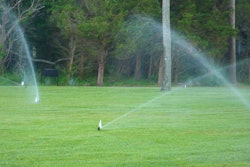
• Water use – Features such as rain gardens, bioswales and porous pavement reduce storm water run-off and restore the natural hydrology of the site. Excess storm water can also be captured in rain barrels or cisterns, and then used to irrigate later. (See page 18 for a look at irrigation’s role in the sustainability movement.)
• Erosion or sediment control plan that conforms to EPA or local storm water management standards
• Plant drought-tolerant native or adapted vegetation
• Reduce heat island effect by increasing shade (planting trees) or using light-colored materials, installing green roofs, etc.
• Reduce light pollution by installing low outdoor lighting levels
Visit leedbuilding.org for more information.
WHAT HOMEOWNERS WANT
Taking steps to capitalize on the sustainability movement could be one way to help weather the current economic crisis. “It’s very likely that we’ll see some significant investment in infrastructure, including ‘green’ infrastructure, as part of federal economic stimulus efforts, and that will benefit both landscape architects and landscape contractors,” Somerville reminds.
For the past several years, many landscape contractors rode the wave of the housing boom, and most recently the “outdoor living room” and “stay-cation” trends. We all know what’s happened to the housing market. And although the financial meltdown of late-2008 has put a damper on the latter two, there is still money on the table.
“Although there has been a cooling down overall, the backyard living opportunities are still available in some markets for most landscape companies,” McShane says. “Rather than relocate, many potential customers have decided to invest in their backyards, which makes a lot of sense right now. We as an industry continue to stress that.”
According to McShane, homeowners looking to enhance their property continue to ask for:
• Water features such as ponds, waterfalls and pottery fountains
• Outdoor kitchens and fire pits
• Garden ornamentation such as bird fountains and statues
• A resurgence of classical and European design in plantings and structures such as English boxwoods and gardens with perennials
• LED lighting and fiber optics in outdoor lighting
“Summer houses and gazebos are another growing trend,” McShane says. “Swimming pools have moved to two extremes:
1) the very formal reflecting-type pool with locking heavy-duty safety covers that mandate a formal design, and
2) natural-looking pools with natural stone, tile and finish. Efficient, smaller non-diving pools (which reduce maintenance, chemical and heat/electric costs) are also gaining in popularity.”
But, as pointed out earlier, the financial crisis of this past fall has caused this market to shrink, generally speaking. The question is: When will it come back—and will you be there to take advantage?
“The design/build prognosis for 2009 is pretty much the same as we experienced in 2008,” McShane says. “There will be a ‘filtering out’ as some weaker landscape companies disappear, but companies with strong balance sheets and management will survive. Contractors who have multiple lines of business with varied clientele will be in a much better position than those who rely on one or two sources of revenue.”
“Five years from now, the economy will have rebounded and landscape design and construction will be a strong growth sector,” Somerville adds. “Communities across the country—both large and small—will be embracing smart growth, low-impact development, green infrastructure approaches to storm water management, green roofs and tree planting, along with other landscape-based approaches to mitigate climate change and create healthier, more livable communities.”
Getting ahead of this sustainability movement, and working to attain buy-in from your commercial and residential customers alike, could help build your bridge to this more prosperous time.
An inside look at non-residential
According to U.S. Census Bureau data through October 2008, total construction spending is down 4.6% from one year ago. Residential spending is down 23.6%, but non-residential is actually up 8.3%. In fact, non-residential spending is up 46% from the same time in 2004.
Here’s a closer look at the primary non-residential construction spending segments, many of which present ongoing opportunity for landscape contractors.
• Lodging – up 17.9%
• Office – up 8.9%
• Commercial – down 11.2%
• Health Care – up 3.9%
• Educational – up 9.5%
• Religious – down 6.3%
• Public Safety – up 24%
• Amusement & Recreation – up 6.1%
• Transportation – up 3.9%
• Communication – down 20.4%
• Power – up 21.9%
• Highway & Street – up 5.8%
• Sewage & Waste Disposal – up 0.9%
• Water Supply – up 16.4%
• Conservation & Development – down 9.7%
• Manufacturing – up 53.7%




![Optimax Sp 0228[1]](https://img.greenindustrypros.com/mindful/acbm/workspaces/default/uploads/2026/05/optimax-sp-02281.lJdm8xL6hQ.jpg?ar=16%3A9&auto=format%2Ccompress&dpr=2&fit=crop&h=135&q=70&w=240)


