
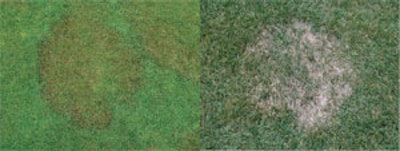
When turf undergoes stress, it naturally becomes weaker and more prone to disease. Mother Nature is most often the cause, but you can be part of the cure. A proactive, all-year plan to help fight turf disease can help you score big points with both residential and commercial customers, and may even lead to more revenue.
In the past few years, abnormal weather patterns have led to increased levels of turf disease across much of the country. Water-logged soils in some areas, and extreme temperatures and drought in others, have compounded the problem of turf stress.
“If conditions are right, disease can set in and cause a lot of damage,” says Kyle Miller, senior technical specialist with BASF Turf & Ornamental Products. “You need to have your eyes wide open, especially during that time of year when you get a lot of disease pressure.”
WHEN YOU'RE UNCOMFORTABLE, SO IS THE LAWN
There’s a general perception that spring is the most critical time of year to apply fertilizer; that’s when you want to kick-start grass growth so you have a lush green lawn for summer. While a spring application is indeed important, Miller says an application in the thick of summer is also a good idea, especially on irrigated cool-season lawns.
“The warmest, most humid summer months are the worst for turf stress,” Miller points out. “Sometimes it’s difficult for the average lawn care professional to catch it early on, because they’re not on a property that often. But as a maintenance contractor who’s coming back to a property every week or so, you can really keep an eye on things. For instance, if you notice a little brown patch starting to occur, you can alert the customer and schedule an application before it gets any worse.”
Summer applications in general are an often forgotten service you can offer. Just because it’s warm out and the grass is growing doesn’t mean it isn’t in need of nourishment. Even on a high-quality turf, disease pressure can quickly set in. And if you fail to stop it from taking over, it can be difficult to get the lawn to come back strong.
“As part of your overall lawn care package, offer a light spring application or two, and add another one in the summer,” Miller advises. “Then, if a property has a history of showing turf disease in the humid summer months, it’s a good idea to schedule a fungicide application just prior to the start of that disease window. Fungicides can be a little on the pricey side, but they’re worth it if the customer is concerned about how his or her lawn looks. Otherwise, they will need to pay to have you come back and reseed in the fall as a result of the damaged turf. ‘You can pay me now, or pay me later.’”
SOMETHING TO FALL BACK ON
In addition to summer, the fall is also a critically important time. A good fall fertilizer application helps promote root growth, which will help the lawn get off to a quicker start the following spring. Your customers will thank you for it. And if you can schedule it in before leaf cleanups are going full bore, you’ll be able to boost your fall sales figures while you have a little downtime.
“Over-fertilizing in the spring does promote lush growth, but that can backfire,” Miller reminds. “A lush lawn—once exposed to heat, moisture and humidity—is the ideal environment for disease. Your best bet is light application in the spring, light application and/or a fungicide in the summer, and strong application in the fall when temps start to come down and grass growth slows. If you do this, you’re almost sure to see a lot less turf stress and disease on a property.”
YOUR MAINTENANCE CREW CAN HELP FIGHT TURF STRESS, TOO
Aside from being proactive and offering effective multi-season lawn care services, there are other things you can do to help fight turf disease. How you mow the turf is the biggest.
You have to mow with sharp blades, so keep an eye on them. Plan to sharpen blades at least every 25 hours. And when they start to become too worn and lose their original shape, you’ll need to replace them.
“It’s good practice to put a new blade on at the start of every season, and more often if necessary,” Miller says. “And you have to keep blades sharp at all times. I look at some contractors’ mowers and you’d think they took a hatchet to the blades.” A jagged blade can lead to turf disease quickly because it tears the grass. It’s kind of like shaving with a dull razor.
Cut height is a second important consideration. If you mow too short, you leave less of a root system because grass is proportional. Furthermore, short grass can’t withstand heat and humidity as well. On cool-season grasses, mowing at 3 to 3.5 inches is a good rule of thumb. On warm-season grasses, make that 2 or 2.5 inches. In either case, never cut off more than 1/3 the actual grass height. And try to alternate your mowing pattern week by week, too.
While not a huge factor, keeping your mower clean can also help. Cleaning your mower after every property is a great idea, but probably not that practical. However, some maintenance contractors say they make it a habit to pressure wash their mower every night to help thwart the spread of disease.
You know what else you can do at night? Irrigate. “It’s imperative that irrigation come on in the middle of the night and go off early in the morning,” Miller says. “Then the turf can dry off in the morning hours when the sun comes out. You don’t want extended leaf wetness. Remember, disease loves high humidity and moisture. Getting the plant dry as quickly as possible is exactly what you want.”
In the grand scheme of things, a lush green lawn is another thing you—and your customers—want. A proactive, all-year plan to fight turf stress can help you achieve it.


![Optimax Sp 0228[1]](https://img.greenindustrypros.com/mindful/acbm/workspaces/default/uploads/2026/05/optimax-sp-02281.lJdm8xL6hQ.jpg?auto=format%2Ccompress&fit=crop&h=100&q=70&w=100)






![Optimax Sp 0228[1]](https://img.greenindustrypros.com/mindful/acbm/workspaces/default/uploads/2026/05/optimax-sp-02281.lJdm8xL6hQ.jpg?ar=16%3A9&auto=format%2Ccompress&dpr=2&fit=crop&h=135&q=70&w=240)


