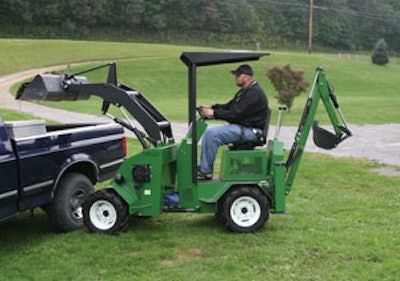
never scoot or tear into the soil.
In landscaping, the projects completed daily are exceedingly diverse. The equipment used to carry out the projects is equally as varied. Choosing between a skid steer, mini skid steer, compact track loader, compact wheel loader or articulated tractor can be especially difficult due to the similarity of their capabilities.
Each is designed to assist landscapers in moving material on the jobsite as well as power attachments available for several specialized uses. In making the right decision, landscapers should carefully consider what specifically the equipment will be used for—and where.
MINDING THE TERRAIN
Many times the bulk of a landscaper's work will be done on properties with existing turf. In this case a compact track loader or articulated tractor may be the best choice. The tracks on the compact track loader evenly distribute their weight to the ground, so as not to dig into the turf. An articulated tractor sits on wheels that move with the terrain, adjusting the pressure of their weight.
"One of the main advantages of an articulated machine is that it will not damage the turf no matter how heavy the machine is," says Kristie Asbury of Power Trac. "The wheels on an articulated machine always roll; they never scoot or tear into the soil like some skid steers might."
When working on a property with existing turf, maintaining its condition can save money and time. If the lawn surface is damaged by equipment, more resources will be spent repairing the jobsite upon project completion.
If the work being done is new landscape installation, as opposed to enhancement, minding the ground condition may not be as important. With installation, priorities often lie elsewhere and the skid steer may be the most appropriate option. It can handle the heavy hauling required with most installations, while the somewhat damaging effects of the weight distribution will not matter to the ground's surface during early stages of installation.
If the user is looking for something that carries the characteristics of both the compact track loader and skid steer, they may want to turn to an all-wheel steer loader, like that offered by Bobcat. "The machine can be switched from an all-wheel steer mode, which offers minimized ground disturbance, to skid-steer mode, which offers an increase in maneuverability," explains Bryan Zent, segmentation application marketing manager for Bobcat.
Beyond the kind of work being done, the location where it is being operated is also important when choosing the right piece of equipment. If the majority of work is in a residential setting, a more compact equipment choice may be ideal. For a small space like a residential yard, the ideal piece of equipment will perform a lot of duties while taking up very little space.
"The skid steer offers the most maneuverability on the jobsite because it can turn within its own radius," explains Gregg Zupancic of John Deere. A compact wheel loader or compact track loader may also be a good option for versatility in tight spaces because of their small size.
Stand-on or walk-behind loaders can offer even more maneuverability in tight spaces, but don't offer the comfort of a seat for the operator. This may be favorable for some users. "A walk-behind is more maneuverable than a ride-on, but of course the operator has to walk," shares Zent. "Being able to get on and off the ride-on platform saves time on jobs where the operator needs to frequently check on the work being done."
Once you are in that tight space, what will you do with the equipment? All of these equipment options offer varying amounts of attachments and systems for linking them to the machine. Determining early on which attachments will be used most frequently can aid in the decision-making process.
"Skid steers and compact track loaders generally have more hydraulic capacity to efficiently run an attachment vs. a wheel loader or a compact tractor, and they have more operating weight than a stand-on mini loader," explains Zupancic. "This enables them to run a wide variety of attachments in many sizes."
Power Trac offers over 30 attachments for their articulated tractor, and with each, attachment is done easily. "All Power Trac equipment comes with our quick-attach feature," says Asbury. "It allows users to change attachments without ever leaving their seat." This option is available from many other manufacturers as well, including Bobcat and John Deere, who offers the greaseless Quick-Tatch coupler. The Quick-Tatch prevents dirt and debris from entering the machine while swapping out attachments, reducing maintenance.
PERFORMANCE THAT PAYS
One thing most landscapers always consider when purchasing a new piece of equipment is the return they will get on their investment. The initial purchasing cost of the equipment varies with their size and attachment capabilities. Landscapers should compare the initial purchase cost to how the equipment will improve efficiency on the jobsite.
The equipment's rated operating capacity, or the amount it can safely lift, has a great impact on the work it is able to do. Generally, the larger the piece of equipment, the higher the rated operating capacity is. If the plan is to do major hauling of materials from one point to another, users are going to want a machine that can haul the most in one trip. This would reduce the amount of trips necessary as well as fuel usage.
Fuel usage and efficiency is a common concern among landscapers. "Generally, the larger the engine horsepower the more fuel the machine will burn," explains Zupancic. "But users should keep in mind that having a properly sized bucket, or one that rolls back a full 45 degrees to reduce spilling a load, are two ways they can optimize efficiency."
Days on the jobsite lost due to wet weather conditions result in a loss of profit as well as decreased customer satisfaction. A compact track loader can help reduce time lost on the job because of its weight distribution and high-performance traction. "Compact track loaders provide a machine platform that delivers superior traction, flotation and stability over comparable-sized skid steers," explains Zupancic. "The result is more production per hour in dry conditions and the ability to operate in slick, wet conditions."
As mentioned before, getting a return on the investment comes down to how quickly the equipment can get the job done. A reduction in time spent traveling across the jobsite increases overall efficiency, reducing costs. "A user can be more productive when traveling between pile and truck when the machine speed is higher," says Zupancic. "Or, if the landscaper does snow removal in the winter when landscaping is slow, then higher speed is generally better and will produce more money."
The goal in any landscape installation or enhancement project is to complete the job within bid and deliver a high-quality result. Knowing which tasks need to be completed can help in making the right equipment decision. The surer you are of your operation requirements, the better you will be at choosing equipment appropriately and cost-effectively.
For more on loaders and tractors, see the rest of this issue.



![Optimax Sp 0228[1]](https://img.greenindustrypros.com/mindful/acbm/workspaces/default/uploads/2026/05/optimax-sp-02281.lJdm8xL6hQ.jpg?ar=16%3A9&auto=format%2Ccompress&dpr=2&fit=crop&h=135&q=70&w=240)


