Landscape professionals may want to see if the growing interest in green roofs can offer new opportunities for them. After all, many green roof manufacturers contract with landscaping companies to actually build the green roof on an existing roof.
Your best bet is to contact the major manufacturers of green roofing systems and find out how they handle their installations and outsource contracting. A listing of green roof corporate members is available at www.greenroofs.org. Do your homework and make sure the company you're looking to partner with is reputable and well-established.
You also want to do your homework on green roofs in general. This article should help you get a good head start.
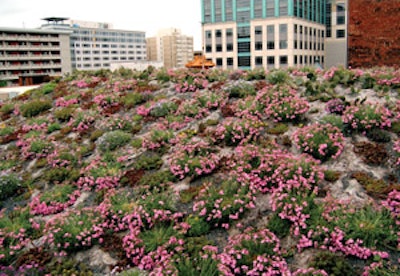
TYPES OF GREEN ROOFS. To put it simply, green roofs are vegetated roof covers. Growing plants take the place of shingles and tiles. While the number of layers and layer placement vary from system to system and green roof type, all green roofs include a single to multi-ply waterproofing layer, drainage, growing media, and plants that cover the entire roof deck surface.
There are two main types of green roofs: extensive and intensive. However, a green roof is often designed with features of both, and are then referred to as semi-extensive or semi-intensive.
A growing trend is to install a modular green roof. With the modular system, soil and vegetation are pre-planted into recyclable modules of varying sizes at a local nursery, usually by landscaping professionals contracted with the manufacturer. They are then simply laid out, one after another, on top of the existing roof, which makes for quick and easy installation.
However, before jumping on the green roof bandwagon, landscape professionals should learn a bit more about the soil and vegetation used for a green roof system, along with the basic principles of green roof maintenance. For without making the proper selections with an understanding of the roof's care, the green roof may not survive.
PLANT SELECTION. The vegetation used for a green roof is usually referred to as plant media. The plants selected are typically sedums, grasses, perennials, native plants and other succulents. Plants native to the area are generally the best choice.
Additionally, the plant media must be hearty, able to withstand most weather conditions, as well as be drought-tolerant. They should also be low-maintenance plants requiring little or no irrigation. In most cases, green roofs are designed to just be "patrolled" on a regular basis. (See "Maintenance and care" later.)
"Sedum has proven to be the most tolerant plant media, especially in shallow soils," says Grace Koehler, sales manager for Midwest Groundcovers, a nursery in St. Charles, IL. "Even with extreme fluctuations in climate, it usually survives, if not thrives."
SOIL SELECTION. In many ways, the soil, or growth media, selected for a green roof is even more important than the plant media. This is because the growth media is the foundation of the green roof. Not only does it anchor the plants, but without the proper nutrients and other components, no matter what plants are selected, they may have a difficult time surviving.
"For instance, it is important that there is enough air space in the soil so that water and oxygen can move through the growth media," says Koehler. "In addition, it must include all the nutrients for the plants to survive the initial installation, as well as thrive."
This is why many green roof systems use engineered soil. This soil is specially prepared to include, among other components, a blend of macronutrients, which are organic nutrients that also have mineral materials.
Among these macronutrients are:
- Nitrogen
- Phosphorus
- Potassium
- Calcium
- Magnesium
- Sulfur
Along with the macronutrients, the engineered soil will also include micronutrients, such as iron, manganese, copper, boron and zinc. Although these are needed in just small amounts, Koehler says they are every bit as essential as the macronutrients for normal plant growth.
MAINTENANCE AND CARE. Unfortunately for landscape professionals, the contracting opportunities may begin to dwindle once the green roof has been installed. Although the first 30 days after installation require irrigation on a regular basis, the core duties beyond the first month primarily involve weeding as necessary, removing debris, and replacing plant media that did not survive. For this reason alone, every green roof needs to be checked periodically.
However, some facilities make regular changes to their roofs, selecting different colors and having the plants arranged in different patterns so that occupants of nearby buildings can take advantage of the view. Facility managers at one hospital in Chicago indicate that they now consider their green roof to be a healing tool, and change the colors and patterns frequently for the enjoyment of patients and staff.
As the business for green roof manufacturers continues to grow, many will be seeking knowledgeable and well-run landscaping companies to grow with them throughout North America. Staying attuned to the growth of the green roofing industry, as well as its trends, developments and technical advances, will be required.
Opportunities like this can prove very lucrative for those who are prepared to come on board. Perhaps thought of as a service ideally suited to commercial clientele, green roof systems are available and being developed for residential settings. Some are do-it-yourself systems, designed for the homeowner to install himself.
However, it's not unusual for the homeowner to turn to a landscaping company to perform the actual installation. Like many of the other add-on services you provide, green roofs could provide a way to set yourself apart from the competition. As the green roofing industry continues to grow, it's probably something worth looking into.
Jim Lindell is the GreenGrid Green Roofs national marketing manager. GreenGrid is a business of Weston Solutions Inc. Lindell can be reached at [email protected].