construction.
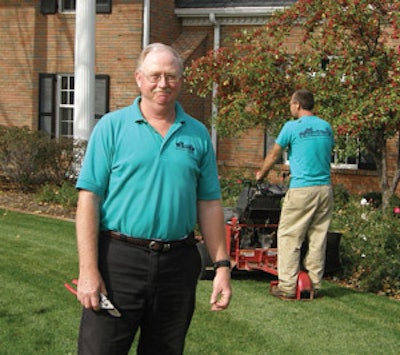
When you live in Wisconsin only a few miles from Green Bay, a few things are constant. You can expect cold and snow during the winter months, and somewhere in your closet will be green and yellow jersey just waiting for a road trip to a Packer game. Gerry Andrews, owner of Landscape Associates in DePere, is no exception.
A native Wisconsinite, he's accustomed to the cold winters, although he doesn't plow snow. Andrews is also a Packer fan—win, lose or draw. In the meantime, he runs a hearty full-service design/build landscape management business, fielding three construction and three maintenance crews.
Maintenance accounts for only 20 percent of Landscape Associates' annual revenue, but look for that to change. This contractor is maneuvering to offset the effects a housing downturn has had on his design/build business. Furthermore, says Andrews, landscape maintenance is renewable and slightly more stable than construction.
LEARNING THE ROPES
Andrews graduated from the University of Wisconsin-Madison in 1974 with a degree in landscape architecture. He worked six years for the Girl Scouts of America designing camps before returning to Madison for a second degree in horticulture. He then spent more than eight years working for two Wisconsin landscape contractors, later going out on his own as a property maintenance consultant.
"I worked out of our garage as a stay-at-home dad," Andrews recalls. "It was a perfect situation since my wife Deb had a career going at an area hospital. My consultant work, though, gradually drew me back into landscape contracting full time as customers wanted me to do more than just advise them on how to maintain their properties."
Andrews purchased some land in 1994 and built an office and warehouse. For the next 10 years, business grew steadily, with Andrews designing and building landscapes, and later maintaining them, primarily for high-end residential clients.
"In landscape design, and also maintenance, you're solving peoples problems," Andrews points out. "That's what I like most about working in this profession. What I don't like is the seasonality, which makes it difficult to pay a living wage, and the commodity label that is attached to maintenance and lawn care." The soft-spoken owner grimaces a bit when he mentions "lawn care." He purchased a lawn care franchise a few years ago, thinking it would be a way to offer customers full service. He's getting out of the business, though, after struggling to get beyond the 800-customer mark.
"In our best year with lawn care, we brought in approximately $200,000," Andrews relates. "The lawn care business has many of the same challenges that maintenance does. Customers don't distinguish between services and service providers, and it's very competitive. Lawn care also has a small selling window, during which you need to be very aggressive. I'm not comfortable selling that way, so the business truly wasn't a good match for our company."
CUTTING OUT WASTE
Nonetheless, Andrews still believes in the natural synergy between lawn care and lawn maintenance. Today, though, his focus is to grow the high-end commercial segment of his market and, as previously mentioned, to add more landscape maintenance customers. He's also concentrating on driving waste out of his operation. "I don't think I'm exaggerating when I say that maintenance departments operate at no better than 75 percent of their capability," says Andrews. "In other words, there is 25 percent waste that can be driven out of most operations, ours included."
He attacked the waste dilemma last year by signing up for the JP Horizons "Working Smarter Training Challenge," a 52-week intensive training program on developing lean management skills. "Lean is about mapping out standards and procedures, but it's also about empowering employees," Andrews emphasizes. "When employees participate in kaizen events and other lean strategy meetings, they are learning to do things their way and not Gerry's way. They are making the important decisions about how to reduce waste."
Landscape Associates' first lean training event targeted a troublesome Homeowner's Association (HOA) account that was routinely over budget. "We looked at labor, how we mowed, and what we used for equipment, and how we loaded and unloaded it," says Andrews. "We even analyzed where we parked our vehicles at the site. The exercise helped us reduce our labor cost by 20 percent.
"We've realized a couple of percentage points improvement in production and 10-percent improvement in inventory management just by reorganizing our tools in both the shop area and on our trucks," Andrews continues. "This is just the tip of the iceberg. Our goal is to standardize and document virtually every phase of our operation, from mulching and mowing to how crews plant trees and trim around them. If nothing else, practicing lean makes employees more aware of how they operate, and it forces a company to measure tasks. Generally speaking, people don't think in terms of doing something in the least wasteful way. With lean, they begin to think that way. It is a great journey."
GROWING A PORTFOLIO
This owner is not content working solely on the bottom line of his income statement. He also wants to grow sales and build a loyal customer base that appreciates value and is willing to pay for it. "We want to grow that part of our business where image is important to property owners," Andrews relates. "We want customers who want seasonal color and understand that pruning and other maintenance details are fundamental to keeping a property looking nice."
Andrews says that it takes more than word-of-mouth to grow a business or new service, especially if you're talking about the high-end commercial market. Getting new business in this market uncomfortably resembles a Catch 22 situation. You can't get the business without first having visible properties to show off.
"To get your foot in the door, you may have to become a little aggressive with your pricing," he emphasizes. "You never want to lose money on a property, but you may not be able to make your desired margin at first, either. Once you're in the door, you can develop those all-important relationships and become the problem-solver for the client, not unlike what I was doing early on in my career when I was a landscape maintenance consultant."
The bid package is also important when trying to obtain new commercial clients, Andrews adds. "We put together detailed specifications that spell out exactly what we're going to do. We also list references, include a history of our company, and, if appropriate, personalize the bid by pointing out current property issues."
WHAT'S IN A NAME?
No matter what market you're in, Andrews notes that all companies evolve; they usually grow and often alter their service offering and customer base to meet changing market conditions. His company is a case in point. The name, Landscape Associates, tells part of the story. Andrews' original intent was to develop strong relationships with subcontractors who would then become "associates." As time went on, providing in-house services seemed more appropriate and profitable for the company—and more to the liking of customers.
Growing the maintenance side of the business and recognizing that a franchise was not a good fit are all part of Landscape Associates' evolution. So, too, is the location. The company is situated right smack in the middle of a residential neighborhood that didn't exist when Andrews built his facility. "We built our office to look like a home, not thinking that we would one day be surrounded by homes," he explains. "It's not a big deal, though. In fact, we blend in nicely with the community and can still use our office landscape to illustrate our landscape design capability."
In addition to the office and warehouse, the property houses a neat shop facility and a structure for holding plant material, along with plenty of room to park three Isuzu cab-over trucks used for maintenance, and three International trucks operated by construction crews. Landscape Associates has a lengthy laundry list of other equipment, as well.
Andrews admits to having a lot of equipment, but that's not unusual for a full-service landscape management company. He says the key is to justify every purchase so it doesn't sit around, and to buy the right equipment for the application. "We recently purchased two mowers that reduced our labor cost by 20 percent," he notes. "That was a good purchase. And as we move forward with lean, we will attempt to make even better buying decisions and standardize our equipment, just as we are standardizing our processes."
As Andrews points out, setting standards and becoming more profitable go hand-in-hand. To get the ball rolling, all owners have to do is commit to making their employees more aware of their surroundings and how they go about their business. Then, it's a matter of empowering them to find ways to eliminate waste, now and forever in the future.
DePere, WI
Owner: Gerry Andrews
Business founded: 1990
Estimated annual sales: $1.5 million
Business breakdown: 80% design/construction, 20% maintenance
Business mix: 60% residential, 40% commercial
Employees: 20 peak season, 8 all year
Fleet includes: Toro Z-Masters; Exmark, Scag and John Deere walk mowers; Stihl and Echo handheld; Bobcat and New Holland skid steers; International and Isuzu trucks





![Optimax Sp 0228[1]](https://img.greenindustrypros.com/mindful/acbm/workspaces/default/uploads/2026/05/optimax-sp-02281.lJdm8xL6hQ.jpg?ar=16%3A9&auto=format%2Ccompress&dpr=2&fit=crop&h=135&q=70&w=240)

