
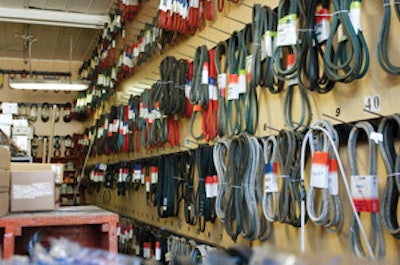
Parts and accessories are often considered to be a power equipment dealer's best profit opportunity, at least in terms of gross margin. As lucrative as your parts operation can be, however, it can also become a hindrance.
Disorganization, excess inventory and dead stock can add cost, reduce profits and impede growth. Even worse, it can drain resources from other areas of the dealership and impede their growth, as well. In other words, what can serve as a cash cow can soon become an albatross, and we're not talking about the web-footed sea bird.
If you want to start making more money in parts, take a look at these seven areas that can directly improve sales, increase margins and reduce costs.
1. Get a handle on inventory
In an effort to determine appropriate stocking levels, most mid-size and larger dealers make good use of their business management systems to track sales histories part by part. If you're a smaller dealer who doesn't have a computerized business management system, you can still get a better handle on your inventory by working with your distributors. "Your reps should be able to reference purchase histories to help determine future inventory needs," says Scott Harris of Oregon Cutting Systems.
Consultant Jim Yount says it's important to look at your inventory needs on a seasonal basis. If you don't, you could end the year with too much inventory on the shelves. In other words, you probably want to bolster inventory levels during peak season, and then pull back a bit when your off-season starts to set in. Your business management system and/or distributors should be able to assist you here, too.
Yount says you never want to allow parts inventory to grow faster than parts sales. If it does, the inevitable result is a lower gross margin from the parts department. The focus should be on inventory turns.
"I'd say six turns a year is a good goal," Harris adds. One way to determine how many times your parts inventory turned over is to take your total parts purchases for the year and divide it by your average inventory, which is your start-of-year inventory plus your end-of-year inventory divided by two. Some analysts say you can use parts sales instead of parts purchases, and may even go as far as saying you can use end-of-year inventory rather than your average inventory.
Regardless of which formula you use, lower turnover rates may point to overstocking, obsolescence and poor marketing efforts. However, as important as turning inventory is, Yount offers a word of caution: "Trying too hard to increase turns can lead to lost sales due to a lower fill rate. If you don't have a part in stock, the customer may not be willing to wait, resulting in lost sales."
"You don't want to overstock, but you also don't want to use your distributor as an overnight warehouse for inventory you should be stocking," says Scott Summers, vice president of Oregon-based distributor Power Equipment Systems. "Many dealers think they're saving tons of money by not stocking a lot of parts. In reality, when you figure the cost of acquiring the part and the time lost, you may not be saving as much as you think."
This is especially true when the part is needed to complete a repair. Summers says a dealer loses, on average, a half hour of labor when he has to halt a repair, order a part, move the machine aside, and then get the machine back out when the part arrives. "This is a big reason why many of our smaller dealers have shop efficiency ratings below 30%," Summers says.
Keeping a larger parts inventory to ensure a higher fill rate does cost more money to maintain, but Yount says you may be able to increase prices accordingly to make up for it. "Many customers are willing to pay a little bit more if they can get the part right then," he adds.
2.Get a handle on margins
To maximize total parts department profitability, you should be examining the profitability of each part you sell anyway. Your business management system should be able to report parts sales by line item. For every part you stock, you need to know the price you paid for it, the price you sell it for, the gross profit dollars and the gross profit percent. For example, if you paid $5 for a part and sold it for $10, your gross profit dollars is $5 and the gross profit percentage is 50%.
Yount says this information is vital because you need to sell your parts not only at a fair market value, but also at a value that allows you to cover your overhead costs and generate a profit. "A 30% average is not sufficient with today's cost of doing business," Yount points out. "If parts account for 20-25% of total dealership revenue, we seldom see profitability when the gross margin on parts is less than 35%. We believe it should be at least 40%, and have actually seen dealers who make more than 50%." (See "Playing within the margins" for a look at what dealers say they are earning on parts.)
3. Manage Vendors
As pointed out earlier, your vendors can help you tailor your inventory levels by referencing your past purchases. They can also help you identify fast-moving parts with their "Top 50" list, for example. These "wearable" items such as belts and spindles are SKUs you always want to have in stock.
Summers says you have to "read the fine print" so you can take full advantage of a supplier's programs. For instance, booking with dating and terms helps you bring in the fast-moving inventory you need to maximize retail sales and keep the service department trucking along.
Another way some suppliers can help you is with a parts return (obsolescence) policy. Yount and Summers concur that you should take advantage of these programs as often as they will allow.
"Every time a part becomes obsolete you lose money," Yount explains. "We have seen obsolete parts total tens of thousands of dollars. Don't let it happen to you. Do not allow your inventory to grow because you didn't take the time to return slow-moving parts."
"Try to keep the fast-movers in stock at all times, and then rotate the rest of your inventory on an obsolescence program every year," Summers advises. "Return your obsolete parts so you can order more fast-movers. There will still be those instances throughout the year where you have to order an oddball part. Do so as a special order and pass the freight along to the customer."
If possible, it's a good idea to tie a special-order part into a larger, perhaps weekly order so you can minimize freight charges. Understanding your vendors' freight programs is another key to making more money in parts. Harris says, "Try to balance your desire to qualify for prepaid freight with your desire for inventory turns."
Summers, who used to be a dealer before joining Power Equipment Systems, suggests ordering twice a week; maybe on a Monday/Thursday schedule. That way you're hopefully placing large enough orders to qualify for prepaid freight, but you're not spending too much time placing and receiving orders.
Prepaid freight falls under the umbrella of a broader concept known as "buying power." According to Mitzi Hedinger, marketing manager for Stens, some dealers cut themselves short by always looking for "the cheapest vendor" on a given part. At the end of the day, though, the dealer may not be saving as much as he thinks because he's limiting his buying power. He can't take advantage of a given vendor's volume discounts because he's spreading his purchases across several vendors.
"By having a single partner in the replacement parts business, a dealer can consolidate his buying power, often get the same or better warranty, and gain access to product lines he otherwise may not have," Hedinger says.
4. Maximize space
The first three steps have dealt with reducing inventory cost and improving gross margin. Step four deals with creating a more efficient, productive environment that will help keep the parts department's net profitability from tanking.
"Look around your parts area, along with your shop, showroom, offices … everywhere," Hedinger advises. "It's amazing how much space can be found once all the waste and clutter is eliminated. We see a lot of dealers who are holding onto old equipment, obsolete parts and other odds and ends that are just sitting around collecting dust. Cleaning those things up will create more room for storage."
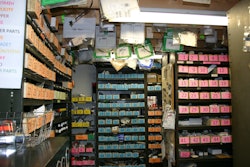
According to Hedinger, Stens has worked with several dealers who have implemented parts storage solutions such as Vidmar cabinets. "Dealers tell us that the cabinets reduce the amount of space used to store inventory, allowing them to keep a more accurate, lower inventory level," Hedinger says. "The cabinets also make finding parts a lot easier."
Harris adds, "Parts stay a lot cleaner tucked away in cabinets. This kind of organization also makes parts returns a lot easier. We've seen a lot of larger dealers going to bin location systems and parts drawers."
5. Assign responsibility
Controlling inventory and maintaining organization is tough to do without those responsibilities landing on someone's desk. Whether that desk is a dedicated parts manager's, yours or someone elses, at least one pair of eyes must keep a constant watch on your parts operation.
A dedicated parts manager is the best way to go, but not realistic for many dealerships. Harris says that until you get to that million-dollar level, where you have five to seven employees and can really start managing your dealership department by department, it's hard to justify a full-time, dedicated parts manager. For smaller dealers, just having a "part-time" parts manager who's in charge of ordering, organization and cleaning out obsolete inventory will be a big help.
What makes a good parts manager these days? "Computer skills are absolutely on the rise," Harris points out. "This is really important for larger dealers who are relying more on business systems and online ordering. Also for larger dealers, having a parts manager who's a little more business-savvy could be more important than having technical skills, though there's still an advantage to knowing the equipment from a service standpoint."
6. Merchandise
You've worked hard to clean up your inventory and improve organization. Now it's time to start marketing your parts department more aggressively to give sales a kick in the pants.
"Our most successful dealers have worked really hard to spiff up their showrooms," Harris says. "There's no rule that says you have to stock your entire parts inventory in the back room. Keep in mind that packaging is a lot better today. Take down some of your traditional signage and displays that you've had around forever. Work with your suppliers to get updated materials and showcase as many of these fast-moving parts as you can."
7. Ask for the sale
If customers don't see these parts on display, chances are, your parts sales will extend little beyond the everyday repair order. "Your parts and service departments should work together to not only perform basic repairs, but also preventive maintenance," Harris says. "More dealers are using the Internet today. Get your customers' e-mail addresses and promote accessory sales and spring tune-ups."
Jim Yount says you should track the ratio of parts sales to service labor dollars. While it's difficult to say what a good ratio is, because there is so much variation from one piece of equipment to the next, this will help you monitor progress. For instance, if you're averaging $1 in parts to every $5 in labor, implement some strategies to help close that gap. If in a month you're now averaging $2 in parts to every $5 in labor, you're making some serious progress. Keep it up.
"When a customer brings a piece of equipment in for service," Yount says, "take two minutes and complete an inspection while the customer watches. Discuss what you see—worn tires, wobbling wheels, cables, lights, switches, filters, seats, blades, saw chain, guide bars, chain brakes, sprockets, hydraulics, leaking fluids, etc. Ask the customer about replacing or repairing each item. Give him or her a guarantee. If you don't have a checklist, develop one. Then, when your business grows sufficiently and you can afford one, hire a service writer."
Aside from the customers coming into your dealership for service, you can also reach out to customers in an effort to boost parts sales. Harris says many of the better dealers he sees have developed parts catalogs for their commercial customers. Those dealers are also seeing an increasing number of parts orders coming through their websites.
Hedinger concurs, saying, "Consumers are more educated than ever and like to shop ahead. They may want to check out their options online, or maybe even place their order online, so their wait time is minimized when they do travel to the dealership. A professional website can give a dealer a leg up."
Staying on the topic of the Internet, most dealers are now using it to place their own orders. Harris says some of Oregon's distributors report that 25-37% of parts orders are now coming in electronically. A good website that offers easy cross referencing, inventory look-up, access to statements and payment information all help the dealer save time and money.
If you're looking to make more money in parts, finding ways to save time will play a big part. Getting a handle on inventory, merchandising and selling more aggressively, getting organized and staying focused will, as well. Put them all together and watch parts profitability soar.







![Optimax Sp 0228[1]](https://img.greenindustrypros.com/mindful/acbm/workspaces/default/uploads/2026/05/optimax-sp-02281.lJdm8xL6hQ.jpg?ar=16%3A9&auto=format%2Ccompress&dpr=2&fit=crop&h=135&q=70&w=240)
