
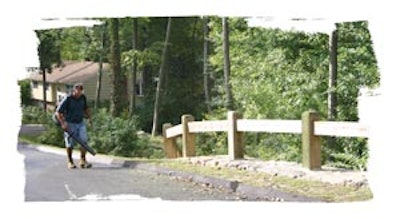
Today’s contractor has more choices when it comes to blowers. In addition to advances in backpack blower technology, handheld models have become a viable option for professionals.
Many of the handheld blowers on the market today are packing a little more punch than in the past. Certain units can even produce wind speeds in the 160- to 190-mph range, which is right on par with many popular backpack models. But that doesn’t mean you should mindlessly reach for your handheld each time you pull up to a property—especially when serious power is needed for extended periods of operation.
A blower’s overall performance comes down to more than just wind velocity (mph). You also want to consider air volume (cubic feet per minute, or cfm) and engine power (hp and cc), not to mention user comfort features that improve ergonomics and boost productivity.
Where, and what, you’re blowing
You also want to look at the types of properties you’re maintaining. Handheld blowers are useful on those quick jobs where convenience is important and noise is of concern.
“We’ve seen growth in demand for commercially built handheld blowers in the last few years,” says Jennifer Dobbs, a sales and marketing specialist for RedMax. “Businesses who want a clean appearance in front are buying them because they’re a quick and cost-effective way to clean off sidewalks.
Municipalities and homeowners are buying them for the same reason. We’re also seeing more demand from landscapers, primarily because more high-end homeowners are outsourcing their lawn care.”
Jay Larsen, Shindaiwa’s marketing manager, says the backpack blower is still the No. 1 choice for landscape professionals, but a commercial-grade handheld can also be an important tool for your trailer. “The handheld is typically faster from truck to task, making it ideal for smaller, residential-type jobs,” Larsen says.
Joe Hickey, a product manager for Stihl Inc., says handhelds are also more efficient if you’re going to be starting and stopping frequently. “Keep in mind that you generally have to take your backpack off to start it back up, or have a co-worker start it back up for you,” Hickey points out. “With a handheld, you can just set it down and pick it back up quickly.”
Jeff Nesom, a product specialist for Husqvarna Forest & Garden, says handhelds are also easier to maneuver in tight areas. Plus, some models can be converted to a vacuum, making them effective when working around flower beds, patios and pools.
The generally quieter handheld also lends itself well to hospitals, condos, shopping centers and resorts, although backpacks have come a long way in terms of noise reduction. In fact, some manufacturers now offer backpack blowers with a lower noise rating than their handheld models.
Something else to consider is the type of materials you’ll be blowing. “Larger, drier leaves are easier to blow and don’t require as much power,” Nesom says. “Pine needles, however, are among the most difficult debris to move, so they require more force.”
You also want to factor in the surface you’ll be working on. Debris slides better on hard surfaces. More coarse, porous surfaces require more power. “Brick patios and decks typically require more blowing power than cement or asphalt,” Nesom points out. “Grass is even more challenging.”
Measuring true performance
It’s all about matching performance to the task at hand, which is why it’s important to consider performance ratings such as mph and cfm. Larry Will, Echo’s retired vice president of engineering who continues to serve the company in a consultative role, says it’s also important to understand the relationship between velocity (mph) and volume (cfm).
“The velocity dislodges leaves and debris from the ground, behind bushes or under cars,” Will points out. “The volume carries the debris away once it’s airborne.”
Hickey adds, “The biggest misconception with blowers is mph. In actuality, you have to look at cfm and mph together. Think about a garden hose.
Without a nozzle, the water just comes out. When you add a nozzle, or put your thumb over the end of the hose, the water comes out faster but you restrict the volume. You have to find that happy medium, which starts with asking yourself what you’ll be using the blower for.”
For instance, you want as much blowing performance as possible when the majority of your customers are commercial accounts, requiring you to regularly clean large parking areas or clear leaves off of lawns. On the other hand, you can have too much power for a given job. If you end up using that same 65-cc backpack blower to dust off grass clippings from a 40-foot sidewalk, even at half throttle, you could end up wasting money on fuel, through wear and tear on more expensive equipment, and by overworking employees with a larger, heavier unit.
The time of year can also play a big role. Larsen says velocity becomes important when you’re clearing heavy, wet leaves in the fall months. In dry conditions, or when clearing grass clippings from sidewalks in the spring and summer, volume is the more important specification.
Regardless, you have to be careful in evaluating measurements such as mph and cfm, especially when it comes to handheld blowers. “Most handheld blowers include a tube with a very small outlet area,” Nesom says. “This gives significantly higher mph but does not move much volume. For example, a 25-cc handheld blower rated at 185 mph will not perform anywhere near the level of a 50-cc backpack blower that can only blow 175 mph.”
Another thing to consider is the fact that some manufacturers label cfm at the fan housing, rather than at the end of the tube where it really counts.
According to Nesom, blower performance can actually vary by +/- 15% depending on the test method.
Furthermore, mph and cfm only provide an indication of actual performance. Another key performance indicator is the blower’s ability to create pressure. Blowers that cannot create good pressure typically struggle to move large piles of debris.
According to Nesom, handhelds often fall into the category of not being able to create strong pressure. “Despite their high performance ratings, handheld blowers will not perform as well when more power is needed,” Nesom says. “This is mainly due to their smaller engine size (32 cc or less), and the simple fact that they aren’t designed to create as much pressure as most backpack units. Unfortunately, there isn’t a published number for pressure that you can evaluate. But you can look at horsepower, because blower performance is directly related to engine power.”
Will explains, “More power means more air flow, and that means a greater area can be cleaned in a given time period. If there is little power, the nozzle must be held closer to the ground. Maybe only a two-foot-wide area is being cleaned without moving the nozzle.”
Nesom and Larsen concur that commercial-grade handheld blowers have become more powerful in recent years because of greatly improve impeller designs, not more powerful engines. “The only way to get a true feel for the actual performance of a blower is to demo it side by side with some others,” Nesom adds.
Convenience and comfort
Demoing is also the only way you’re going to get a true feel for how comfortable it is to operate a given blower. That’s because comfort is a matter of personal preference. “Some users prefer convenience to comfort,” Will says. “It’s always more convenient to grab a handheld unit than it is to strap on a backpack.”
But if you have a lot of area to clean, the lighter handheld may actually be more tiring in the long-run. Handhelds tend to fatigue the operator’s wrist, due to the gyroscopic effect of the impeller and internal components of the engine. While padded handles and lighter impellers have lessened this gyroscopic effect, most manufacturers and users would agree that, if operating the blower for periods longer than 15 minutes, a backpack will be a better choice from a comfort standpoint.
Several features go into making a backpack blower as comfortable to operate as possible. Weight is among the most important. Hickey says an extra four or five pounds can make a big difference, especially for operators who are blowing all day.
“You have to ask yourself, ‘Do I already have enough power?’” Hickey says. “If you buy a heavier blower to get more power—power you don’t really need—it’s probably not worth it.”
Where the weight is carried is just as important as the weight itself. “In order to minimize fatigue and stress, the weight should be carried as close to the operator’s back as possible,” Nesom points out.
Padding strap thickness is key, but the width of the strap is even more important. Wide straps spread the load and don’t cut into the operator’s shoulders.
Nesom says he always recommends a hip belt, especially for extended use. “This transfers the weight of the machine to the operator’s hips, rather than the shoulders,” Nesom explains, “which creates less stress on the back. “It also helps secure the machine to the operator.”
Other important comfort features include back pads, adjustable handles and throttle control mechanisms, and anti-vibration cushions that isolate the engine from the operator.
Hickey reminds about one more important buying consideration: run time. If you’re having to stop too frequently to refuel your blower, you’re losing money as a result of downtime. Look at the size of the fuel tank and how fuel-efficient the engine is. Quiz your dealer.
While you’re at it, ask your dealer about things such as mph, cfm, engine power and creature comfort features. Each is an important consideration when choosing the right blower for the task at hand.





![Toro Dingo 2 v Rl3 Nemkm J[1]](https://img.greenindustrypros.com/mindful/acbm/workspaces/default/uploads/2026/01/toro-dingo-2vrl3nemkmj1.OTWvRpZ7qT.jpg?ar=16%3A9&auto=format%2Ccompress&dpr=2&fit=crop&h=135&q=70&w=240)


![Doosan Bobcat Wacker Neuson Stack 2ec Js Pb V6e[1]](https://img.greenindustrypros.com/mindful/acbm/workspaces/default/uploads/2025/12/doosan-bobcat-wacker-neuson-stack2ecjspbv6e1.CPyyz8ubHn.png?ar=16%3A9&auto=format%2Ccompress&bg=fff&dpr=2&fill-color=fff&fit=fill&h=135&q=70&w=240)


![T708 2025 Ga Tl11 R3 Hr [1 Q5 A1066]](https://img.greenindustrypros.com/mindful/acbm/workspaces/default/uploads/2025/10/t708-2025-ga-tl11r3-hr-1q5a1066.KcuUhTiF78.jpg?ar=16%3A9&auto=format%2Ccompress&dpr=2&fit=crop&h=135&q=70&w=240)
