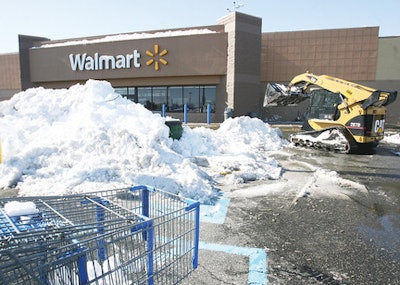
The recent failure of a huge, national service provider is a stark reminder that snow removal contractors cannot lowball their way to prosperity.
After USM Services Holdings Inc. (commonly referred to as US Maintenance) was fired by Walmart and later sold to EMCOR Group, several snow removal contractors say there’s a lot to be learned from this experience.
Lesson 1: Individual contractors need to take action. Stephen Fuzinski, owner of Green Sweep Inc. in Toledo, OH, suggests that each company can take charge by knowing their true costs and understanding what they need to charge in order to provide excellent service and earn a profit from each job.
“You’ve got to look at each situation, and don’t be afraid to walk away. Don’t be afraid to know it’s not going to work,” adds Sam Granados, owner of Denver’s Integrated Snow Removal.
Many contractors who lose clients to lower-bidding competitors often win those jobs back within a few years.
“They always come back to us. People are expecting quality service, and we know snow removal is not a game,” Fuzinski points out.
Lesson 2: Customers need to know what’s going on. The management team of a large retail chain must understand the true cost of snow removal services. They need to know how much the subcontractors are being paid, the quality of subcontractors hired and the cost of store closings. When those factors are understood, the corporate offices can make informed decisions on the true savings or costs provided.
“It’s human nature to have selective memories,” Granados says, noting that retail stores continue to hire new national companies to provide services when others have failed. But, he adds, understanding the true costs of snow removal can only benefit the stores over time.
Lesson 3: National companies must follow a different business model to be successful in providing a quality service and turning a profit. Granados says national companies should understand the markets they are entering and hire quality subcontractors.
“I have nothing against the national companies, but some just have gone about it the wrong way,” Granados says. “It’s been a very reactive form of conducting their business. Some of these national companies don’t own snow removal equipment and don’t have the management in major metropolitan areas. The snow removal industry needs to be hands-on to be successful.”
Crystal Arlington, owner of the national service provider Affiliated Grounds Maintenance, says there is definitely a model for national companies to succeed. The businesses must define clients’ priorities, confirm the contracts are fair and provide the right types of education to subcontractors.
“One thing we can’t do is put everything on the backs of small contractors. As larger companies we need to educate them, go over clients’ expectations and provide guidance,” Arlington says.
National companies that follow a business plan that allows them to partner with contractors will lead the snow and ice management industry into the future, Arlington speculates.
“I think the large stores are realizing that the cheapest price isn’t going to give them the best value. If national companies are smart, take on regions slowly and do a good job, things will go well,” Arlington says.
Why “lowest price” isn’t fool-proof
When Fuzinski found out he’d lost his Walmart account, he later learned US Maintenance would pay subcontractors just 25% of what his company (Green Sweep) made the year before.
"We were getting $70,000 a season to plow the same Walmart,” Fuzinski relates. “The average Walmart should cost $68,000 to $70,000 a season. That’s a good number, and that’s what you need to earn to provide the level of service they need and expect."
Contractors across the country have shared similar concerns. They say US Maintenance—and some similar national companies—enter a market and drive the price of jobs so low that contractors cannot provide an adequate level of service to ensure customer satisfaction and safety.
“It just doesn’t add up,” says Granados. “They go in and promise to save people money, put the squeeze on the subcontractor, and it’s a Catch-22. It’s a death spiral.”
Simply put, contractors who are underpaid are going to have a very difficult time meeting performance standards.
Large retail chains enter national contracts with service providers to lower administrative costs, receive a cheaper rate by signing in bulk and have a clear understanding of who is providing the service.
But, when some national companies put the jobs out for bids, they offer subcontractors a fraction of what the national retail store is paying, ultimately reducing the quality of the snow and ice management the store is predicting.
“The Walmart stores expect the same level of service they have been getting, but they’re actually only receiving (a fraction of the) service,” Fuzinski says.
Contractors say they cannot adequately train their people, service the equipment and manage each storm for the small amount of money they receive from a national company.
“It was a challenge to work with US Maintenance,” says John Chiarella, president of Connecticut-based Ultimate Services Snow & Ice Management. “They paperwork you to death and don’t provide loaner equipment or support. When we work on our own, we can provide clients with a better level of service and a better price.”
The big storms kill you
In the 2010-2011 winter months, Walmart faced significant weather-related challenges. Storms at the end of December left 20 of the East Coast stores closed for a day during the busy shopping period after Christmas. Ten locations stayed closed for a second day. Anecdotal evidence suggests Walmart stores across the country faced service-related problems on top of the challenges the storms presented.
“Crews responding to last week's historic ‘dump’ did remarkable jobs in clearing the highways. Even many neighborhoods were quickly attended by local crews and smaller plows … The only area that seemed to need more pre-planning and attention was the Walmart parking lot. Thursday it was still a mess with obstacle snowdrifts,” Missouri resident Hal Anway wrote in the Lake Ozark News’ opinion section in mid-February.
When stores are forced to close or address weather-related accidents, the true cost of snow and ice management increases dramatically. The 20% savings national management companies promise can be wiped away in just a few days.
“Walmart got fooled. They got fooled into believing they would save money and get a certain level of service,” Fuzinski said.
EDITOR’S NOTE: Walmart’s corporate office did not return calls for comment, and store managers declined to comment, due to corporate rules. US Maintenance also did not return requests for comment.








![Big Blade Logo1 f J4 Pu6 V Kz8[1]](https://img.greenindustrypros.com/mindful/acbm/workspaces/default/uploads/2026/04/big-blade-logo1fj4pu6vkz81.5dLpAOAm7X.jpg?ar=16%3A9&auto=format%2Ccompress&bg=fff&dpr=2&fill-color=fff&fit=fill&h=135&q=70&w=240)


