
Snow removal contractors have a lot of choices when it comes to deicing. Understanding which product is best-suited to a specific situation is becoming increasingly important in today’s hyper-competitive market.
“Snow removal professionals are facing a number of challenges today,” says Sara Matuszak, brand manager, Morton Salt. “What product should they use? How much should they carry? How can they be prepared for a deicing event? How can they compete head to head with increasing competition? By applying the right amount of the most temperature-appropriate melter, snow pros will have answers to all of these questions.”
“Professionals need to be knowledgeable about product attributes,” adds Mary Kay Warner, marketing manager for International Salt. “Then they can select the appropriate product while facing a multitude of varying weather conditions.”
Both International Salt and Morton Salt are owned by The K+S Group. Here’s their take on what snow pros should be looking for when selecting an ice melt product.
Recent testing shows …
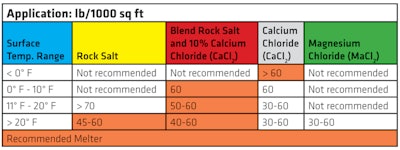
Morton Salt recently partnered with Michigan Technological University to test the melting performance of common ice melters under different real-world environmental conditions and varying application rates. “The results of the study highlight guidelines for which melter and application combination will help drive strong melting results in the most cost-effective manner,” Matuszak points out.
For instance, the study showed that in sub-zero temperatures, calcium chloride is really the only effective option. On the other hand, magnesium chloride is not very effective when the temperature dips below 20° F. Sodium chloride (i.e. rock salt) is your best bet when it’s 20° F or warmer. For most conditions, a combination of rock salt and calcium chloride is the most cost-effective option.
Know what you’re dealing with
Generally speaking, there are three scenarios snow removal contractors have to deal with: normal winter conditions, colder than normal conditions, and environmentally sensitive areas. Understanding your environment and the needs of the customer are essential to choosing the right deicing agent.
Normal conditions. There are many instances when a contractor simply needs a cost-effective product that will melt ice in temperatures down to around 15° to 20° F. This is why rock salt is so popular. “Morton’s Safe-T-Salt Rock Salt works well in normal winter temperatures and is a highly economical ice melter,” Matuszak says. “In temperatures above 20° F, this product actually outperforms calcium chloride.”
International Salt's Halite Salt Crystals represent a high-purity salt product that is specifically screened in the production process to obtain crystals that provide optimal coverage whether dispersed manually or in a mechanical spreader. This is an effective product for frequent use throughout snowfall periods to prevent ice from forming on ground surfaces.
Cold. When temperatures dip into the single-digit range, however, contractors have a whole new set of challenges. They also have a new selection of deicing products to choose from.
Morton offers its Ice Melter Blend (a combination of sodium chloride and calcium chloride flakes). “Independent studies showed that this blend outperformed both rock salt and calcium chloride in temperatures above 0° F,” Matuszak points out. “So basically, professionals can melt ice faster and longer, but at a much lower cost.”
When temperatures dip below zero, contractors need something that’s fast and powerful. That’s why calcium chloride has become so popular, since it works effectively down to -25° F. “If time is of the essence, we recommend Morton Calcium Chloride,” Matuszak says. “It actually generates heat on contact with the ice and snow to melt faster than plain salt.”
International Salt’s Arctic Thaw Ice-Melt Blend combines calcium chloride and calcium magnesium acetate (CMA). It also generates heat on contact to quickly break the bond between pavement and snow/ice. It’s designed to work down to -15° F. “The blue crystals are easy to see so that winter maintenance professionals can achieve even application,” Warner adds.
C-Force Calcium Chloride Pellets and Flakes, also from International Salt, works effectively in frigid temperatures—even lower than -25° F. “This 100% calcium chloride product generates heat through an exothermic reaction, resulting in rapid melting of ice and snow,” Warner says.
International Salt’s Blizzard Wizard is another product for when below-zero melting performance is required. While it doesn’t contain calcium chloride, the company says Blizzard Wizard’s special formulation and blending process grants it unique performance characteristics.
“Blizzard Wizard is a proprietary, blended product containing sodium chloride, magnesium chloride, molasses and Ice B’Gone,” Warner explains. Ice B’Gone, a product of Sears Ecological Applications Co., is an 80/20 magnesium chloride/molasses blend. It relies on the fact that low molecular-weight carbohydrates (such as molasses), when mixed in correct proportions with chloride salts (such as magnesium chloride), cause a lower freezing point, otherwise known as a synergistic freezing point depression.
“Blizzard Wizard is distinctive because all components are thoroughly blended as opposed to topically added,” Warner adds. “That yields a product that is consistent throughout and provides below-zero melting capabilities.”
Environmentally Sensitive Areas. Blizzard Wizard is also considered to be environmentally sensitive. Its unique formulation helps reduce both corrosion and overall salt use. The product actually earned a “Design for the Environment” designation from the U.S. Environmental Protection Agency (EPA).
Another example is Morton’s EcoSafe Ice Melter which contains a sealing agent which helps prevent concrete damage. It also contains plant growth agents which make it safer for plants. EcoSafe works effective when the temperature is above 5° F.
Continuing education
There’s a lot to consider when choosing a deicing agent. The rising cost of running a snow removal business, coupled with the mounting downward pressure on pricing, make it all the more imperative that the right choices are made.
“There’s a desire on the part of winter maintenance professionals to have access to a variety of ice-melt products in order to achieve the desired outcomes required by their varying customer bases,” Warner says. “This results in the need to be as knowledgeable as possible concerning ice-melt ingredients and their respective attributes in order to make appropriate product selections.”
International Salt has invested in the development and presentation of seminars at industry-related events. “The number of attendees at our seminars, as well as those presented by other ice-melt manufacturers, underscores the trend that contractors are eager to learn more about the products available,” Warner points out.
Morton Salt is helping bring useful information to contractors through the use of new media. The company has developed a smart phone app called Morton Pro. It allows snow professionals to enter and store site locations and surface area. “When a plowing event hits, snow pros can enter-in environmental conditions to receive melter and application amount recommendations,” Matuszak explains. “The app is designed to help snow pros maintain their sites safety and efficiently.” Morton Pro is currently available for download to iPhone/iPad and droid platforms.







![Pmc Wing High Res Jpg Scaled E1635126559354 2v1 Xj I1 Xyd[1]](https://img.greenindustrypros.com/mindful/acbm/workspaces/default/uploads/2026/09/pmc-wing-high-res-jpg-scaled-e16351265593542v1xji1xyd1.8iliVmaE4J.jpg?ar=16%3A9&auto=format%2Ccompress&bg=fff&dpr=2&fill-color=fff&fit=fill&h=135&q=70&w=240)


