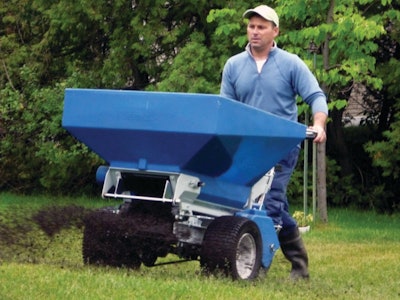
Topdressing is an essential procedure in the maintenance of sports fields and golf courses. It is natural, sustainable, and superbly effective. Residential lawns will flourish with the same procedure and it is no wonder this service is gaining in popularity.
For lawn and landscape professionals who want to maintain a profitable business, topdressing represents a great way to share in an expanding market—and to do so responsibly and with sustainability. Today's customers are more attracted to eco-friendly practices that produce great results. Now it’s possible to offer residential clients the same effective procedures previously only available to golf course superintendents and turf managers.
What is topdressing?
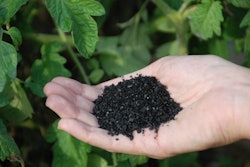
Topdressing is the direct application of a layer of soil mixture onto grass. The thickness of this layer varies from 1/8 to 1/4 inch. Top soil is usually used for sports fields, but a soil containing at least 75% compost is recommended for residential lawns.
Why topdress?
Whether it is included in a maintenance program or used to restore damaged lawns, topdressing with compost offers many advantages that are usually found in other maintenance procedures but separately. According to Roy Gross, from St. Louis Composting Inc., “We are looking for results when we decide to topdress.”
Topdressing, when applied correctly, rejuvenates a lawn and has a beneficial effect on flowers, trees, and shrubs. The application of one single layer of compost fulfills between 50% to 100% of the annual fertilizing needs. Compost is the only slow-releasing soil amendment containing all of the necessary nutrients. Furthermore, compost significantly improves water retention and the soil structure, stimulates microbial activity, breaks down thatch, and neutralizes the pH.
New equipment
Golf courses and sports turf managers are topdressing fans. They are able to topdress between two and four times a year because they work with high-capacity, tractor-drawn equipment. And why are they so diligent? Because topdressing produces great results.
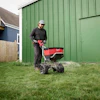
In recent years, the emergence of efficient and easy-to-use equipment designed for residential areas allows landscapers to provide professional topdressing services and respond to increasing demands for natural practices from their customers.
Scott Morrison, from Morrison Power Equipment in Plymouth, MA, states: “We saw the same phenomenon with the introduction of the aerator in the 1990s. Before that, soil aeration was only used on sports fields and golf courses. Today, all professional lawn care companies provide this service in residential areas.”
Expand your customer base
Topdressing allows lawn care professionals to offer a new service that is not a gimmick, but rather an effective and eco-friendly addition to their other services—increasing their market share and their revenue. Dustin McGehee, from Greenside Outdoor Services, Louisville, KY, offers this perspective: “In order to maintain and expand my business, I had two choices: either offer the lowest bid or offer something different. So, I chose topdressing. This method allowed me to stand out from my competitors and acquire new customers.”
There are three steps to offering top dressing services to residential clients:
1. Estimates: The best way to determine the cost to clients is by counting the cubic yardage. Measure the dimensions of the area that will be topdressed.
For topdressing, the application rate is 1 cubic yard per 2,000 sq. ft.
For turf renovation, the application rate is 1 cubic yard per 1,000 sq. ft.
Multiply the cost of the compost, including delivery, by 4 or 5, depending on the use:
Compost cost X 4 for commercial (or any area over 10,000 sq. ft.)
Compost cost X 5 for residential (or any area less than 10,000 sq. ft.)
2. Educate Residential Clients: We are all concerned about our health and the quality of our environment. Having less pesticides and synthetic fertilizers on our land—or avoiding them altogether—is the key to a healthy and safer environment. To accomplish this, we all need to turn our attention to the soil. The principle is simple: Healthy soil produces healthy plants.
3. Timing: Spring and fall are generally the best periods for topdressing turf. To obtain maximum results, the yard should be mowed prior to topdressing. After topdressing, the yard should be watered regularly for two to three days.
Once reserved for sports fields and golf courses, top dressing is now increasingly popular among residential and commercial clients. Where previously, bulky tractor-driven applicators made it prohibitive, new equipment created specifically for residential and smaller commercial lawn care gives landscapers the opportunity to provide professional, natural, and profitable services to their clients.