
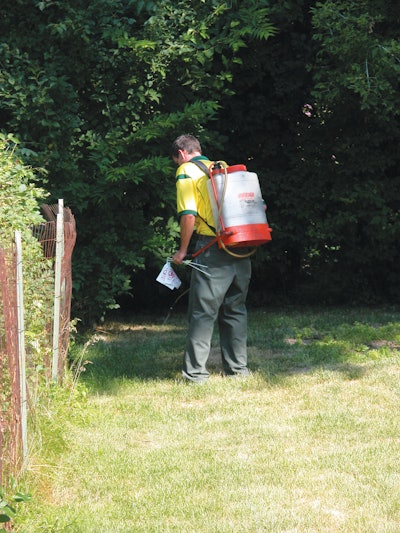
Wild weather shifts have left many lawns stressed, battered, and in some instances, broken. Even though it’s October, there’s still plenty of time to stress to customers that certain actions need to be taken this fall and winter to help ensure the healthiest lawn next spring.
Effects of the early spring, dry summer
“The early spring meant that pre-emergents were put down much earlier than usual,” says Jim Goodrich, product sales specialist for professional turf and ornamental products at PBI/Gordon Corporation. “When soil temperatures started to quickly heat up in July, some pre-emergents started to fade sooner than you’d like.”
The good news, Goodrich says, is that the summer was so hot that there hasn’t been much weed activity. On a similar note, most regions haven’t had many issues with fungus. Water and humidity are needed to create a favorable growing media for fungus to develop. “Irrigated lawns obviously have some need for fungicides,” Goodrich points out, “but the fungicide market as a whole has suffered considerably this year.”
Problems popping up this fall
By late August, some regions began to see some drought relief. As a result, some turf issues have begun to sprout up this fall.
Sedges. “Sedge thrives in warm, moist conditions,” says Adam Manwarren, turf and ornamental product manager for FMC Professional Solutions. “The late-season rains have contributed to significant outbreaks later in the season. This will result in a much larger issue next year due to prolific tuber production. Controlling sedge with a pre-emergent application will be a key initiative for lawn care contractors.”
A product such as FMC’s Dismiss can help control sedge outbreaks. Manwarren explains, “During the fall, sedges are actively loading carbohydrates and other sugars into tubers to serve as energy for next spring’s emergence. As nutrients and moisture are taken up by the roots and delivered to tubers and rhizomes, Dismiss is transported into the nutrient flow, affecting viability and reducing sedge density the following spring.”
Grubs. Goodrich has been concerned about a strong insect population. “We’ve been anticipating this due to the mild winter we’d had. In some respects, it’s already proven to be true. Ornamental insects, piercers and suckers, have remained active. But grub activity hasn’t really blossomed. That could change now, though. Soil temperatures were so warm this summer that grubs were staying down deep. Now that things are starting to cool down, those grubs might start to surface.”
Armyworms. When things started to green back up in late August, fall armyworms also began to emerge in force—especially in the Southeast. “Any lawns that survived the summer drought could be taken out by a strong armyworm population this fall,” Goodrich alerts.
Stink bugs. These critters prefer the cooler autumn weather. On the heels of the historically hot summer, cool nights began to occur by early September. “This is driving stink bugs indoors for protection from the elements,” Manwarren points out. “If these cooler nights persist, many lawn care contractors will not have had a chance to complete their final perimeter applications. You have until the end of October to apply a product such as Talstar Professional, which will help keep stink bugs out for the winter.”
Late-fall recovery tips
Late-season outbreaks of insects and sedges aside, there are other things which contractors and their customers should be considering.
“Some lawns have been completely wiped out,” Goodrich says. “The grass has gone dormant and will not come back.” When that’s the case, it’s obviously time to re-seed. But first, Goodrich says, contractors should apply a product such as GlyphoMate, a non-selective weed and grass control with the active ingredient glyphosate. “As soon as this product hits any living plant material, it kills it,” Goodrich explains. “But once it gets tied up in the soil, it’s not active any longer. So a contractor can come right in behind it to re-seed.”
If you’re dealing with a lawn that doesn’t require a complete renovation, hitting the touch-up spots with a broadleaf weed control is important. “Our SpeedZone product allows contractors to come back and re-seed after seven days,” Goodrich says.
Bob Avenius, a regional technical manager for TruGreen, also stresses the importance of fall weed control. “Along with seeding, the right combination of fertilizer and herbicide can take average turf and make it stand out,” he says. “New seedlings need nitrogen, phosphorus and potassium. Nitrogen is the main nutrient that greens up the turf and provides the needed stimulus to thicken and develop a root system.”
The last application of fertilizer should be made when the turf has slowed down, but the mower is not quite ready to be stored for the winter, according to Avenius. So there’s still time for many contractors across the country.
As for herbicides, they can be applied fairly late in the season, as well. “Later applications may not completely control weeds, but the winter will control the survivors,” Avenius points out. “The turf should then be weed-free the following year.”
Setting the stage for next spring
As we move into 2013, Goodrich says contractors need to be ready to hit hard with pre-emergents in early spring. “A lot of weed seeds have been sitting dormant because they didn’t have a chance to flourish this year,” he explains. “There’s a good chance for an outbreak next spring. So be ready for that.”
Goodrich also says contractors should be thinking about the possibility of a repeat. It’s not likely that the weather will be as volatile as it was this year, but you still need a plan in case it is.
Products such as TransFilm can be applied to dormant turf and trees to help prevent water loss. It’s a good product to apply right before winter, but can also come in handy during the summer if signs of drought start to emerge.
Also, if another drought comes to pass, think about what you could do to help prolong the “green” of your customers’ lawns. Liquid nitrogen applications are one possibility. “Our FeRROMEC product is a liquid iron product that ensures plant production of chlorophyll,” Goodrich says. “That causes a rapid shift to the dark green, healthy color most consumers desire. This is safe to apply during a drought, so it’s something to think about next year.”
Something to think about right now is getting a hold of your clients to schedule a site visit. Explain the serious issues their lawns could be facing right now, and also next spring. Prevention is the best medicine.

![Optimax Sp 0228[1]](https://img.greenindustrypros.com/mindful/acbm/workspaces/default/uploads/2026/05/optimax-sp-02281.lJdm8xL6hQ.jpg?auto=format%2Ccompress&fit=crop&h=100&q=70&w=100)





![Optimax Sp 0228[1]](https://img.greenindustrypros.com/mindful/acbm/workspaces/default/uploads/2026/05/optimax-sp-02281.lJdm8xL6hQ.jpg?ar=16%3A9&auto=format%2Ccompress&dpr=2&fit=crop&h=135&q=70&w=240)


