
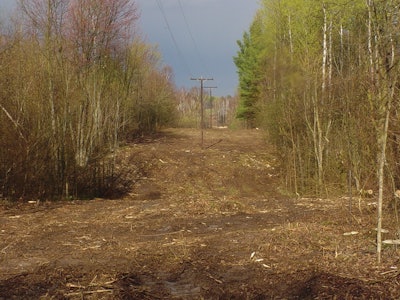
The right-of-way maintenance business is not for the faint of heart. It’s extremely low-bid-driven and equipment-intensive. Contracts can be lucrative, but are often somewhat fleeting. Needless to say, contractors like Todd Olerud are under quite a bit of stress.
But that’s just how it goes in the right-of-way maintenance business, Olerud says, so you have to learn how to live with it. Over the course of his 20-plus-year career, Olerud has definitely learned how.
“We have a lot of competition, so margins are pretty tight,” says Olerud, owner of New Age Tree Service in Spring Grove, MN. “Historically, many clients (rural utility co-ops) simply looked for the contractor that came in at the lowest hourly rate. But that’s starting to change, which is a good thing.”
Focus on improving production
Olerud started New Age Tree Service back in 1994 after racking up years of experience working for another right-of-way maintenance company. Olerud actually started out with a partner, but the partner backed away after just six months. Olerud continued, determined to see his vision through.
“One of the reasons I started my own company was because I had a lot of ideas for how to do this type of work more efficiently,” Olerud says. “This work is very labor-intensive (40% of sales), but was even more labor-intensive back when I first started out. I saw an opportunity to create a more mechanized operation that was focused on high production as opposed to maintaining a low hourly rate.”
Initially, this concept was anything but an easy sell. The rural utility co-ops looking to hire contractors such as Olerud were fixated on the lowest bidder. At that time, lowest bidder equated to whomever said they would perform the work at the lowest hourly rate. Thus, contractors with inferior machinery, personnel and operating systems often won bids.
“Years ago, the co-ops were happy with two guys and a bucket truck,” Olerud tells. But today, due to tighter budgets and a better understanding of long-term costs, co-ops are more interested in higher production and job quality. Some co-ops have even put full-time arborists on their own staffs to help ensure that contractors are completing the work like they’re supposed to.
“Many bids now are production-based,” Olerud points out. “Lump-sum bidding has also become quite common. For example, we might be asked how much we’ll charge to do an entire 110-mile-long substation, based on the co-op’s specs.”
This works to Olerud’s advantage. His fleet of bucket trucks, Terex track loaders and productivity-boosting attachments—together with his veteran staff of skilled employees—help put him in a good position come bid time.
Assembly-line approach
Olerud and his team have devised an assembly line-like approach to completing jobs.
- Track loader with mowing attachment comes through (see photo)
- Track loader with tree shear attachment removes danger trees, rotten trees and dead trees
- Bucket truck comes through to trim remaining trees (see photo)
- Track loader with grapple attachment moves all logs to the side and the lighter brush to the middle
- Track loader with mowing attachment comes through once more to grind all of the brush stacked in the middle
- Track utility vehicle comes through to spray herbicide (see photo)
Sounds easy? Well, it is—and it isn’t. This approach, Olerud says, has definitely led to an increase in productivity. But these jobs are big jobs, taking a long time to complete and often leading employees far from home.
“There’s a lot of variance from one job to the next, and a lot of that depends on how much neglect took place before we started our work,” Olerud points out. “Some projects are like tree trimming jobs, but others are almost like logging jobs. I guess it’s fair to say that most of these projects take six months or so.”
New Age Tree Service performs work in Minnesota, Iowa and Wisconsin. “Most of my employees live near me in Minnesota,” Olerud says. “When we travel to a job, we’ll pile in vans. If the job is going to take several months, as most do, we try to find a house to rent. Employees are each granted a per diem for food and other expenses. We’ll then work Monday through Thursday, driving back home on Friday for a long weekend.”
3 keys to success
Employees. Olerud says employees are the biggest key to success in the right-of-way maintenance business. “They’re the ones out there doing the work,” Olerud reminds. “I can bid all day long and make all kinds of promises, but if my employees don’t do the work right, none of it means anything.”
That hasn’t been much of a problem for Olerud in quite a while. Many of his 24 full-time employees have been with him since 1996. Why do they continue working for him? “I think it helps that I’m on the jobsite with them,” Olerud says. “I go through what they’re going through. A lot of company owners hang back at the office. But I like being in the field with my team.”
The rural utility co-ops which New Age works for seem to appreciate that, too. “One advantage of hiring our company is that you’ll be dealing with the very people who helped build our company,” Olerud says. “Our company has grown, but is still ‘small’ in this sense. Our employees take great pride in what they do because they feel like this is their company, too.”
Safety is another key to success. In fact, in this line of work, it’s a necessity. After all, employees are operating aggressive machinery around potentially dangerous power lines and pipelines.
“We need EHAP (electrical hazards awareness program) training every year,” Olerud points out. “We also need CPR and First Aid training. We’re also accredited through the Tree Care Industry Association (TCIA).
“It seems like we’re always having safety meetings or sending employees to safety training,” Olerud continues. “Some co-ops don’t realize how much this costs companies like ours. But it’s getting better. Back in the 1990s, there wasn’t a lot of pride in this business. A guy with a pickup and a chainsaw was in business. There’s more of an expectation today. Safety and training are not just something good companies do for their employees—they’re becoming a requirement and something the co-ops look for.”
Dealer support is a third key to success for Olerud. He was one of the first contractors to begin using ASV track loaders back in 1995. When ASV was acquired by Terex in 2008, Olerud stuck with them.
“You need strong dealer support to make it in this business,” Olerud says. “You simply cannot afford more than a few days of downtime all year. The (Terex) dealer in Grand Rapids, MN, goes way above and beyond. It seems like so many suppliers are just looking at the bottom line anymore. They don’t seem interested in the end-user. But both our Terex and Vermeer dealers understand that their success is based on our success. They’ll even come in after hours to help us out.”
Growth must be controlled
This kind of vendor support has helped New Age Tree Service grow over the years. But Olerud isn’t anxious to grow too quickly.
“Someone once told me: ‘Anybody can create the monster but very few can feed it every day,’” Olerud shares. “I think that’s great advice. We grew like crazy in our first few years. Then, in 1998, we had the rug pulled out from under us on a few big contracts. It sent us into a tailspin. I learned a lot from that.
“If you’re going to grow, grow slowly,” Olerud continues. “The hardest part is that you’re only dealing with a handful of clients at a time. This year we have four. Some are longer-term contracts, but many are one job and done. We always have others asking for bids, but it gets a little stressful because you’re not sure where the next job is going to be.”



![Optimax Sp 0228[1]](https://img.greenindustrypros.com/mindful/acbm/workspaces/default/uploads/2026/05/optimax-sp-02281.lJdm8xL6hQ.jpg?ar=16%3A9&auto=format%2Ccompress&dpr=2&fit=crop&h=135&q=70&w=240)


