The availability of cordless, battery-powered handheld lawn equipment has increased over the past couple of years. While homeowners represent the biggest market for these products, professional landscape contractors are also finding a use for them.
"The vast majority of our end customers are homeowners, but we do have some professional landscapers as customers," says Lauren Gomez, marketing manager for Worx. "We're delivering more and more power, and can provide pros with a quieter and emission-free alternative to gas."
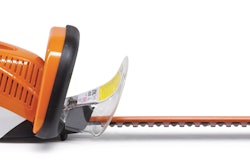
Stihl Inc., a leader in gas-powered handheld equipment, got into the battery business in 2010 with its HSA 65 hedgetrimmer, which won a Popular Mechanics Breakthrough Award. Stihl has since expanded its battery-powered offering to also include two string trimmers, a handheld blower, a chainsaw, a push mower, and an extended-reach hedgetrimmer (being introduced this spring).
Oregon PowerNow is another recent entrant into the battery-powered category. They offer a chainsaw, string trimmer/edger and hedgetrimmer. "Now more than ever, battery-powered tools should be in the consideration set for contractors," says Josh Huffman, senior product line manager for Oregon PowerNow. "There are product options that offer high performance and quality, in addition to the convenience of battery or cordless alternatives."
Why would a pro switch from gas to battery?
Contractor Raul Berrios of RulyScapes Inc. in Centreville, VA, is using the Stihl chainsaw, hedgetrimmer, string trimmer and blower. "A big advantage is the lighter weight," Berrios says. "But the biggest thing is the environment, mainly from the customer's perspective."
Reduced sound is another benefit. "With some of our homeowner customers, if you show up on their lawn at 7:30 in the morning, running gas-powered trimmers and blowers, they probably will ask you to come back later," Berrios says with a chuckle.
Performance-wise, Berrios says the string trimmer and hedgetrimmer seem to be on par with their gas-powered counterparts. "The blower is not quite as powerful, though," he points out. "But for what we use it for, mainly cleaning up hardscape jobs and blowing grass clippings off of sidewalks, it works just great."
Many landscape maintenance contractors are finding that battery-powered handheld equipment can be very useful on certain properties. According to Dan Pherson, a product manager with Stihl Inc., hospitals, condo complexes, homeowner associations, and neighborhoods with noise restrictions are ideal settings for battery equipment. So are properties and locales with stringent emissions requirements, such as LEED-certified buildings.
Then there's the concept of green marketing. Demand for green products continues to grow. In fact, some survey studies suggest that 75% of consumers are interested in greener approaches to lawn care. Kelly Giard, founder of Clean Air Lawn Care based in Fort Collins, CO, is one example of a contractor who has capitalized on this opportunity. Founded in 2006, the company now operates 40 franchise locations in 10 states.
How might it affect your pocketbook?
Make no mistake, battery-powered equipment that is fit for a pro is not inexpensive. Once you purchase the tool itself, and then a good battery and charger, you will end up paying considerably more for a battery-powered unit as compared to gas—sometimes more than double.
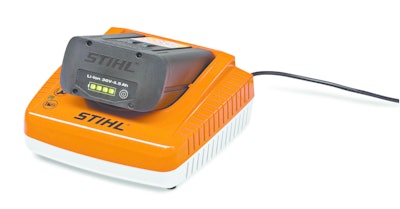
For example, Stihl's HSA 65 battery-powered hedgetrimmer retails for roughly $300. The AP 160 battery goes for another $200 and the AL 300 rapid charger goes for $90. That's a total upfront cost of $590. Comparably, Stihl's HS 45 gas hedgetrimmer sells for roughly $300, which is $290 less.
However, contractors should look at total operating costs, not just purchase price. According to Pherson, Stihl's HSA 65 hedgetrimmer costs just 2 cents per hour to operate—which is about 95 cents per hour less than a comparable gas unit. What does that mean? The battery-powered unit will have cost the same amount as the comparable gas-powered unit at roughly the 305-hour mark ($290/0.95).
Are battery products good enough?
The next question is: Will this battery-powered tool perform just as well as a gas unit, all the way up to this 305-hour mark? Maybe not four or five years ago, but some can today.
"Our crews operate Stihl and Black & Decker battery-powered handheld equipment," Giard relates. "It's really a matter of user preference. The 18-volt Black & Decker trimmers are a bit lighter and more ergonomic, which is important for a more inexperienced user. But the Stihl trimmer feels like a gas-powered machine. The horsepower is there, too. They work very well on our commercial routes."
Product technology has come a long way over the past few years. And when you're talking about product improvements with respect to battery-powered equipment, you're largely talking about the battery itself.
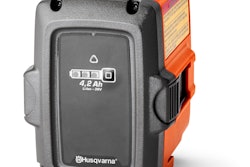
Gomez says batteries are becoming lighter and more powerful, delivering longer runtimes per charge. Pherson agrees, adding, "Stihl's newest battery, the AP 160, can be charged hundreds of times without a loss of power." In fact, Stihl says this battery can be charged 500 times and still retain roughly 80% of its original capacity.
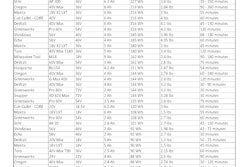
The other key is how quickly you can recharge a battery. Stihl claims an approximate 35-minute charge time for its AP 160 using its higher-end AL 300 rapid charger. Oregon PowerNow's B400E battery can take 30 minutes to two hours, depending on the charger. The Worx 24-volt GT trimmer battery takes three to five hours to charge.
Many pros who are using battery equipment invest in multiple batteries just to be safe. Giard has installed solar panels on his trucks so a battery is always charging while the other is in use. Stihl offers a battery belt so pros have a backup battery at the ready while out performing work.
That's going to add cost, which you must keep in mind when pricing work. There are plenty of benefits to using battery-powered equipment. But just like with any piece of equipment, you have to do your homework—and have a clear plan for putting the equipment to work for not only your crews, but also your bottom line.