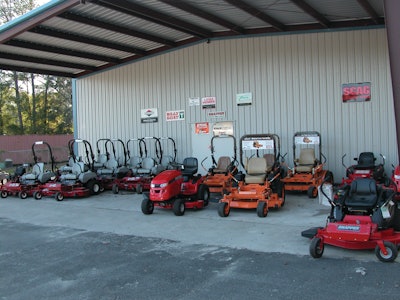
For many dealers, there are two sides to the showroom. The A side comprises all the hot sellers, while the B side comprises inventory that just doesn’t seem to move. Fortunately, strong performance from the A side often results in a pleasing cash flow spike during peak selling season. But a lot of that much-needed cash now has to pay for the B side of the showroom. That’s not a very good reward for a prosperous season, is it?
“It’s easy to turn cash into inventory, but not always so easy to turn inventory into cash,” says sales and marketing consultant Rick Barrera. “You have to get obsessive about moving inventory—especially slow-moving and obsolete inventory. When you eliminate interest cost and free-up floor space, your profitability really changes. And it creates quite a bit of excitement in your store.”
Barrera says slow-moving and obsolete inventory should never exceed 5% of your total inventory. A variety of circumstances can result in excess inventory. Some are at least partially out of your control, such as unpredictable weather patterns or an economic downturn in your market. Others are well within your control, such as poor forecasting and/or purchasing. If you happen to overdo it a bit on your early-season orders, you need a strategy to unload any slow-moving inventory before it becomes obsolete. When the inventory becomes obsolete, it becomes that much harder to move.
Start early with a plan
Always be thinking about selling slow-moving inventory in-season—before it’s too late. Generally speaking, outdoor power equipment retailers have a bell-shaped sales curve. Sales gradually climb until about mid-season, and then start to wane as winter approaches. You want to begin focusing on slow-movers at the peak of your bell curve, which is mid-season. That way you have enough time to make some adjustments and get inventory moving before the next model year approaches. If you wait until October or November, that slow-moving inventory is now obsolete.
Focus on it
The emotional tendency is to ignore inventory that isn’t moving, but you should actually do the opposite. You must focus on this inventory and create some excitement around it. Build a display with nice signage. Offer demos. This is especially important if the model was once a hot seller, but is currently experiencing a slowdown in sales, leaving you with some extra inventory.
Whether you’re a three- or 10-person operation, you may want to consider assigning someone to slow-moving inventory. It’s this person’s job, at least once a week, to go through sales histories and the floor plan to identify which models aren’t moving, and which have interest charges bearing down on them.
Control stocking methods
This is especially important for handheld product. When a new shipment of “Model X” comes in, it’s a natural tendency to stack it on top of the inventory you already have for that model. What happens? The units you already had in inventory, which are probably coming a lot closer to being due, are “shoved to the back.” Make sure all employees understand the importance of bringing the existing inventory “to the front” so it is sold first.
Discount it to a price that will move it in seven days
You must use your judgment on this one. The price you come up with may even be below cost, but that could be worth more in terms of total cash flow when compared to carrying the unit through to next season.
Sell it online
Today’s consumers are using the Internet to buy and sell many different products, including power equipment. It’s worth a shot.
Barter it
You buy all sorts of products to keep your business running, such as office products, gasoline, advertising, uniforms and shop supplies. See if any of your vendors might be interested in doing a trade for that tractor you can’t seem to sell.
Triangle trade it
This is very similar to the barter concept presented above, but also involves a third participant. For instance, you could trade a tractor to a local radio station for advertising time. The radio station may then use the tractor in a giveaway promotion. You can turn around and trade that advertising time to a local electronics retailer for a flat-screen TV. In turn, you can use that TV in your own giveaway promotion, or even put it to use in your dealership as part of a display.
Bundle it with a high-margin, related product
Toss in that slow-moving hedgetrimmer with a hot selling zero-turn, or bundle it with a bunch of gardening tools. The secret is to bundle the slow-mover with a high-margin item(s) so the “blended margin” is acceptable.
Bundle it with something unexpected
You don’t always have to bundle a piece of outdoor power equipment with another piece of power equipment. You can bundle a slow-mover with an Apple iPod, set of hand tools, labor, or maybe that flat-screen TV you’d triangle-traded with the radio station and electronics store for.
Substitute it for a lower-cost item
Consider the following scenario: You have a chainsaw that isn’t moving, but is one of your higher-end saws. The saw has a direct cost of $500 and retails for $650. A customer comes in and wants to buy a $450 saw. You might want to try selling that $650 slow-mover for $500. Sure, you’re selling the saw at cost, but you’re also bringing in more cash ($500 vs. $450). Most importantly, you’re unloading a slow-mover before it becomes obsolete.
Dealer trades
Check with other dealers to see if they have a need for any of your slow-movers. This can be very effective if you have an employee assigned to slow-moving inventory. A good rep will also help you here.
Extended financing and warranty
The manufacturer is already offering two years, so why not offer a couple more? You do your own service. What’s the potential cost of parts in those two extra years compared to the cost of carrying that slow-moving unit over the winter? On financing, what does it cost you to buy extra time? Add another six months to what’s already being offered by manufacturer.
Get out there and find a buyer
Take your slow-moving inventory to the fair, swap meet or mall and set up a display. Have a blow-out sale. You’ll bump into the people who didn’t set out to buy a tractor that day. These customers aren’t comparing prices and vendors, etc. It becomes an impulse buy, which is just what you’re looking for with extra value like extended warranties and bundles.
Donate it to a local church or other organization
Be sure to talk to your accountant so you are able to take full advantage of the tax benefits.
Host a giveaway or auction
Hold a drawing and give away that slow-moving tractor at the chain saw open house in early fall. Use the slow-mover as a traffic builder. Similar to holding a contest, take all slow-moving summer inventory and hold an auction at your fall open house. You can always set a reserve so the bidding can’t go below a certain amount.
If possible, swap it
Check with your supplier to see what kind of “swap program” is available. Some manufacturers will allow you to swap, for instance, walk mowers for chain saws, debris blowers or snow throwers—some product that will get you back to the upside of your selling curve for the fall and winter timeframe.
Grit your teeth and pay the restocking fee
Even though they’re hard to swallow, restocking fees are often your best bargain. Of course, you don’t want to pay a restocking fee on something you can sell, especially if you’re still on the upside of the selling curve, or even in the middle. The closer you get to the backside of that curve, however, the greater the value of the restocking fee. Furthermore, if you have interest coming due on a unit, the restocking fee will often be less than the interest you’ll end up paying.
When all else fails, you can always take your obsolete inventory apart and use it for parts, or simply trash it. But hopefully, by focusing on slow-moving inventory before you hit the backside of your selling curve, you’ll be able to turn it into cash and profit for you.









![Optimax Sp 0228[1]](https://img.greenindustrypros.com/mindful/acbm/workspaces/default/uploads/2026/05/optimax-sp-02281.lJdm8xL6hQ.jpg?ar=16%3A9&auto=format%2Ccompress&dpr=2&fit=crop&h=135&q=70&w=240)


