
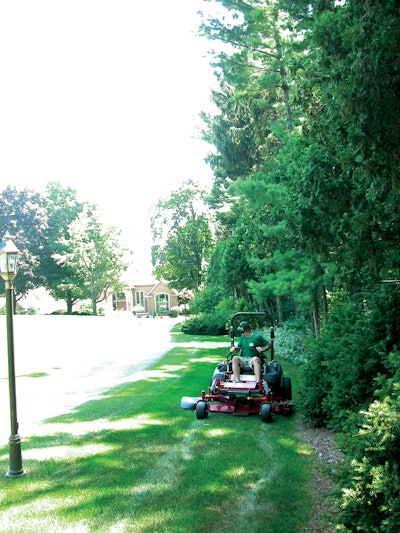
To some consumers, landscaping and lawn care are necessary investments. To others, they are necessary evils. To others, landscaping and lawn care are discretionary and, thus, quite expendable when household budgets tighten up. Each of these types of consumers often end up paying for landscaping and lawn care services, but how they value the services and what they look for in a contractor can differ greatly.
That's why many landscape contractors say that success in residential lawn maintenance all depends on who you target and how you market. Some have shifted their sales efforts toward higher-income households and higher-value homes. Some are customizing their service offerings, payment plans and/or incentives in order to generate new leads and maintain the flow of revenue. Others are relying more on online lead-generation services like Angie's List, TaskEasy, GreenPal and Mowz to find new residential customers. Whatever the case, there is one constant: The contractors have a plan.
Upselling additional services
Robbins Landscaping in Richmond, VA, has grown its residential maintenance business over the past five years. Some of the company's growth has come from upgrading existing client contracts. For instance, the company started offering in-house irrigation services via a full-time technician who was brought on staff. “This didn't prove to be a ton of revenue right off the bat, but it did add another $25 or $30 to an account each month,” says Doug Robbins, company owner.
The point is that you have to be willing to take on new projects and services as they present themselves. “Keeping in touch with the property owner is huge,” Robbins says. As the economy started to change in the 2008-2010 timeframe, Robbins Landscaping saw a significant portion of its design/build business coming from maintenance accounts, rather than vice versa. As consumer confidence and discretionary spending power continue to improve this year and hopefully in the future, these types of upsell opportunities will likely become much more abundant.
To help promote his company's diverse service offering, Simeon Meyer of Prairie Hill Horticultural Services in Lake Villa, IL, has had some success with invoice stuffers. “We've included letters to let people know what else we have going on at that given time,” he explains. It’s beneficial that Prairie Hill is able to offer a full range of mowing, detailing, lawn care, snow removal and property cleanup services. It helps separate them from the many mow-and-blow operators in the area.
Referrals
That competitive separation, in part, is why referrals seem to be holding their own for Prairie Hill Horticultural Services. Meyer says being a member of the Better Business Bureau and having an A+ rating helps a lot. Prairie Hill has also worked to improve its website, www.phhort.com, along with its social media presence on Facebook.
Invoice stuffers have come into play here as well. “Sometimes I insert flyers that our customers can pass out to other homeowners,” Meyer says. “Another thing that’s worked well is referral cards customers can fill out for a friend so we can provide them with a free estimate.”
Robbins has also had success generating new residential leads by focusing on referrals from his existing customer base. Robbins Landscaping hits existing neighborhoods with direct mail. Job signs (18 x 24) are posted on all design/build projects, which help promote the company’s maintenance services.
Incentives
Prairie Hill’s referral incentive showed some success early in its execution. For example, for each friend or neighbor that ultimately signed a 2011 landscape maintenance agreement, the customer received one free mowing valued at $50.
Out in Colorado, Chris Binkley of Silver Peak Services really ramped up the incentives when he wanted to generate new leads a couple years ago. This Colorado Springs-based company initiated a coupon magazine campaign at the onset of spring. The mailer goes out quarterly. “The response was unbelievable in both April and June—almost too much to handle,” Binkley says.
The coupons in April and June offered 10% off sprinkler repair. A second, more successful promotion offered four weeks of mowing for $99 with a fifth week free. “We set a maximum of 5,000 square feet,” Binkley points out. “Most of the yards here are 2,000 to 3,000 square feet, so I was comfortable with the price. Many of the residential lots we have are upper middle class. A few are military families where the husband is deployed and the wife doesn’t want to mess with the yard.”
A third successful promotion was a lawn mowing package for $115/month. It included mowing, trimming, blowing, three fertilizer applications, bi-monthly weed control and monthly edging. “This really had a good response and helped us double our accounts from the previous year,” Binkley says.
Customers have been responding well to this type of service bundling in order to get the value they want. As another example, Binkley says there are numerous contractors in his market who perform spring aeration services, but he takes it a couple steps further. “I do aeration, but also offer power raking and spring fertilization.”
Be careful not to “give it away” though
Binkley offers one important note: “The hardest thing we face as a company when offering these types of specials is keeping costs down so we turn a profit for all of the services offered together.”
Robbins takes it one step further. “The most dangerous thing we can do is give our services away. When I talk to a client, I explain that we value their business and are confident they’ll be happy with our work—but we just can’t afford to lower our prices, even by 10%. I show them that we must work off of a 10% profit margin in order to sustain our business. If we lower our prices by 10%, we are working for free, and that doesn’t make any sense. We push that ‘one-stop shop’ concept as the added value a client gets from hiring us. Then it’s my responsibility as the owner to make sure the client understands that value.”
Personal attention
In today’s changing market, Robbins says everything has to be about the customer. “Years ago it was all about the work you’d done in the past,” he explains. “That’s great, but now it has to be more about how you are going to solve this customer’s problem.”
In residential maintenance and even small commercial, Meyer thinks clients are looking for someone trustworthy who knows what they are doing and can answer a question when needed. “We make sure our employees are knowledgeable with horticulture, not just how to mow a lawn,” Meyer says.
In Waunakee, WI, the Schall brothers of Greenstripe Lawns & Landscapes say that visibility with clients has been an important part of their early success. “It helps that Adam and I are on properties maintaining quality,” Brandon says. “This makes a big difference in high-end residential. The wife and kids can trust the landscaper. Even the dog can.”
The Schalls started their business in 2005 while still in college. They’ve grown every year. “We focus on subdivisions with $400,000 homes and up," Adam says. "When you have families and careers like these people do, you need to hire someone to take care of your lawn.”
Greenstripe has come to rely on Ferris mowers. Brandon says the independent suspension on the riders has had a positive effect on not only productivity, but also customer satisfaction. “Our employees don’t get beat up so much when mowing all day,” Brandon explains. “So they’re happier when working on properties, and customers notice that.”
Residential maintenance contractors who are dominating today are taking every little edge they can get.







![Optimax Sp 0228[1]](https://img.greenindustrypros.com/mindful/acbm/workspaces/default/uploads/2026/05/optimax-sp-02281.lJdm8xL6hQ.jpg?ar=16%3A9&auto=format%2Ccompress&dpr=2&fit=crop&h=135&q=70&w=240)

