Safe mowing on steep slopes requires understanding that manufacturer slope ratings represent maximum climbing angles under ideal conditions, not necessarily safe working limits. Contractors must assess site-specific conditions including ground stability, traction, weather, and operator positioning to determine if equipment is suitable, as factors like wet grass, loose soil, and hidden obstacles can cause loss of traction and instability even within published slope limits.
- Slope ratings differ: Maximum climb angle, maximum operating slope, and site-specific limitations are three separate parameters that contractors must evaluate independently.
- OSHA guidance: For ride-on mowers without manufacturer specifications, OSHA recommends avoiding slopes steeper than 15 degrees, though this does not apply to remote-controlled equipment.
- Traction is incomplete: Tracks provide traction but cannot guarantee stability on wet grass, loose soil, mud, erosion, hidden holes, or vegetation-covered uneven ground.
- Weather reduces safe limits: Wet conditions can significantly reduce the maximum recommended operating gradient for remote-controlled mowers below published maximum values.
- Operator safety matters: Remote operation removes the operator from the machine but requires safe positioning away from the equipment, with proper distance determined by manufacturer instructions and site-specific risk assessment.
Steep slopes, roadside vegetation, and uneven commercial lots can all make routine mowing difficult and dangerous. For landscaping contractors, choosing the right equipment involves more than just comparing cutting width, engine power, and hill-climbing capability; it also requires understanding how the machine performs on different surfaces, how operating conditions affect stability, and the risks that may still exist even when the operator is away from the equipment.
For this reason, remote-controlled mowers offer more options for managing complex terrain. However, their suitability depends on the specific machine model, the attachments used, and the conditions at the job site. Understanding these limitations is crucial for making informed equipment decisions.
Maximum Climbing Angle is not the Same as Safe Working Limit
When comparing equipment, slope ratings are useful but need to be clearly explained. Manufacturers may publish the maximum climb angle, maximum working slope, or limitations for mowing in specific directions. However, these figures do not necessarily represent the same capability.
Three parameters should be considered separately:
- Maximum climb angle: The steepest slope a machine can climb when tested under specific conditions.
- Maximum operating slope: The maximum slope permitted for specific operations, as specified by the manufacturer.
- Site-specific operational limitations: Limitations determined by the machine's specifications, ground conditions, operating methods, and on-site risk assessments.
For example, when evaluating commercial lawn mowers, contractors should establish the specifications of the maximum climb angle; maximum allowable slope for mowing; and the restrictions on driving on cross-slopes, turning, and operating on wet ground based on the manufacturer's technical documentation. There are strict requirements that apply depending on the product series. Find your equipment's maximum allowable slope for mowing. Trimmora
Applicable conditions should accompany these figures. Grade ratings without information on test conditions and operating limitations provide an incomplete picture of the machine's performance.
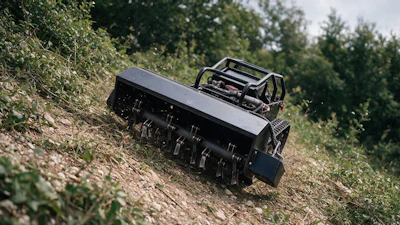
 An example of maximum grade during operation.Trimmora
This is important because slope-related incidents may involve loss of traction, instability, sudden steering inputs, or inadequate equipment maintenance. The Occupational Safety and Health Administration (OSHA) recommends that employers adhere to the manufacturer's slope limits for lawn mowers. When the manufacturer's instructions are unavailable or do not specify operating limits, OSHA recommends that ride-on mowers avoid slopes steeper than 15 degrees. This guidance applies only to ride-on mowers and should not be considered a general operating limit for remote-controlled machines.
Research by the California Department of Transportation (Caltrans) offers a useful real-world perspective. Its evaluation of remote-controlled lawn mowers used for roadside vegetation management includes two seasons of on-site testing. The report examines how these machines can be used on steep slopes and in restricted areas, where traditional equipment may risk overturning or creating traffic hazards for workers. It also identified practical limitations that require further evaluation, rather than establishing a safe slope angle for each remote-controlled lawn mower.
 Traction plays a major part, but it's not the whole story.Trimmora
Traction is Only Part of the Equation
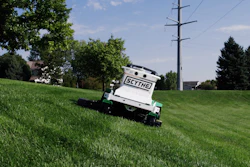
Tracks help distribute the machine's weight and provide traction on certain types of terrain. However, they do not guarantee stability on every slope.
Wet grass, loose soil, mud, erosion, hidden holes, and vegetation covering uneven ground can all affect how the machine moves. The mower may lose traction before reaching its published slope limit. Sudden changes in direction or obstacles hidden beneath vegetation can also affect its stability.
The British Association of Landscape Industries (BALI) has identified loss of traction, machine instability, components popping out, and flying debris as risk factors associated with operating remote-controlled mowers on slopes.
Additionally, weather is a contributing factor. BALI's guidelines specifically warn that in wet conditions, the maximum recommended operating gradient for remote-controlled mowers may be significantly reduced. Operators should consult the manual to understand the machine's specific limitations rather than assuming that the published maximum values apply under all conditions.
If site conditions exceed the equipment's permitted operating limits, contractors should choose an alternative method or divide the work into areas that can be managed safely. Operators should not be pressured to start the machine simply because the equipment is already on site.
This is why surface conditions are just as important as the angle. Even with the same measured slope, a dry, solid embankment and a wet, recently disturbed slope may present very different risks.
 Patrol the job - clear out hidden obstacles like rocks. Trimmora
Remote Operation Changes the Operator's Position, But They're not Without Risk
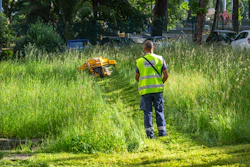
One practical reason for using a remote-control system is that the operator does not have to ride on the machine. This can reduce certain hazards associated with steep embankments, roadside slopes, and other hard-to-access areas.
However, the operator still needs a safe working position. Standing on a slope directly beneath a machine in operation may expose the operator to the risk of the machine slipping or tipping over. The operator must also be mindful of flying debris, nearby workers, the public, and obstacles that could interfere with the machine's movement.
Safety distances should be determined in accordance with the manufacturer's instructions and a site-specific risk assessment.
Selecting Equipment for Practical Applications
When evaluating remote-controlled mowers, contractors should not exceed the maximum slope requirements. The equipment's cutting width, machine weight, track design, center of gravity, cutting system, ground clearance, and vegetation type all affect its suitability.
In addition, the expected direction of operation should be considered, as well as the manufacturer's specific restrictions regarding whether the equipment is intended for mowing up and down slopes or across them. Furthermore, machines suitable for maintaining grassy embankments may not be suitable for dense woody shrubbery, soft ground, or sites with frequent obstacles.
Remote-controlled equipment is not necessarily the best choice for every job. Traditional mowers remain practical on suitable, accessible terrain. Other areas may require the use of handheld equipment or different specialized methods. The goal is to match the equipment to the conditions, rather than assuming a single machine can handle all tasks.
Mowing steep slopes is about more than just finding a machine that can handle steeper gradients. Working safely depends on understanding the equipment, assessing the site, and recognizing when conditions exceed the machine's limits.
Remote-controlled mowers can expand a landscape contractor's options, but best practices dictate treating them as specialized equipment rather than a shortcut in risk assessment. Knowing when not to mow is just as important as knowing what the machine is capable of.