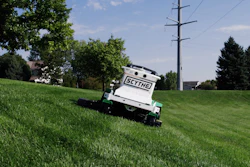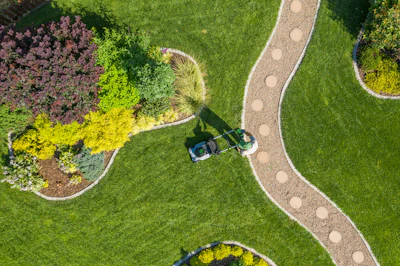
It’s 2030. A landscape maintenance company is managing thousands of acres. Trucks still move from site to site, but much of the routine turf maintenance is performed autonomously. Employees who once spent entire days operating commercial mowers are now focused on irrigation management, enhancement work, pruning, drainage solutions, and customer relationships. The company has not reduced its workforce; it has simply changed how that workforce is deployed.
Does it seem an ambitious scenario? Actually, the forces making it possible are already reshaping the landscaping industry.
Just as mechanization in the mid-20th century multiplied what a worker could accomplish in a day, and electrification in the 2000s improved working conditions, automation represents a fundamental shift in the operating model. The industry is moving past the era of human-operated machinery to an era of human-directed autonomy: systems that execute repetitive tasks within boundaries people set, while the control rights remain firmly with the team.
Rethinking the 'More Trucks, More Crews' Formula
For years, industry growth has been closely tied to labor availability. Securing new contracts meant adding crews, another truck, another trailer, and additional mowing equipment. It was a simple model, but one built on the assumption that labor would always be readily available.
Today, that assumption is increasingly difficult to sustain. Demand for professional landscape maintenance services remains strong, yet many contractors face the same obstacle: finding enough qualified workers to perform the job.
The objective is to free up time and resources so that human expertise can be applied where it creates the most value.
This labor crunch impacts a massive footprint: the U.S. landscaping industry includes approximately 692,777 companies employing more than 1.4 million workers. These businesses compete for the same pool of talent not only with other industry operators but also with construction firms, logistics providers, warehouses, and delivery services.
Additionally, labor costs continue to rise. The National Association of Landscape Professionals projects that labor expenses will increase roughly 20 percent between now and the end of 2029, adding further pressure to maintenance contracts that are already absorbing higher fuel, equipment, and insurance costs.
Against this backdrop, mowing deserves particular attention because it represents one of the largest recurring cost drivers in landscape maintenance, as well as one of the most repetitive tasks performed by field crews. Every acre requires hours of labor, transportation, fuel, equipment maintenance, supervision, and planning: the process repeating week after week throughout the growing season.
When contractors calculate the total cost of professional mowing, market estimates typically range between $70–$90 per acre, depending on labor rates, property characteristics, route density, and service frequency. This range reflects a widely accepted industry benchmark derived from NALP mowing productivity data, publicly available contract pricing examples, and typical commercial landscaping rates for large, relatively unobstructed properties. For decades, this cost structure has remained largely unchanged.
Today, however, these numbers may finally begin to shift. Based on data collected for the Sunseeker X9+ robotic mower (for illustrative purposes only), high-utilization deployments can drive operating costs down to approximately $12 per acre. This figure is calculated by applying the industry-standard three-year amortization lifecycle of a traditional gas mower to the X9+ MSRP, factored against the total number of mows performed per season over that three-year window.
This reduction of costs fundamentally changes how a business thinks about growth. As mentioned, the expansion meant proportionally increasing labor and equipment, while in the future growth will depend increasingly on the ability to integrate technology with human expertise.
The goal is not to replace workers. In fact, many companies would gladly hire more qualified employees if they could find them. The objective is to free up time and resources so that human expertise can be applied where it creates the most value.
This shift is particularly important because customers are increasingly demanding services that go beyond basic mowing. They want more efficient irrigation systems, solutions to drainage problems, improved plant health care, and landscape enhancements. These are services that require technical expertise, judgment, and field experience.
Yet, many companies still dedicate a significant portion of their workforce to repetitive tasks simply because they must be completed on a regular basis. Automation has the potential to rebalance this equation, allowing employees to focus on higher-value work and, often, more profitable services.
The Next Competitive Advantage
Companies that lead the industry over the next decade may not necessarily be those with the largest fleets or the biggest crews. More likely, they will be the ones capable of achieving the highest productivity from each employee and each asset they deploy.
As costs continue to fall and operational familiarity increases, mid-sized and residential-focused companies will begin integrating autonomous systems into mixed fleets.
In this context, robotic mowing is no longer just a new product category — it becomes a strategic decision. The industry has already been shaped by innovations that changed how work is done, from the introduction of zero-turn commercial mowers to advances in fleet management and routing software. Automation may represent the next major inflection point in that evolution.
Adoption is also likely to accelerate unevenly across the industry. Larger contractors and municipalities with predictable turf maintenance needs are expected to lead the transition first, as they can achieve the highest utilization rates and fastest payback periods. Over time, as costs continue to fall and operational familiarity increases, mid-sized and residential-focused companies will begin integrating autonomous systems into mixed fleets. This gradual adoption curve will reshape competitive dynamics, rewarding early adopters who learn how to optimize deployment models before automation becomes standard practice across the industry.