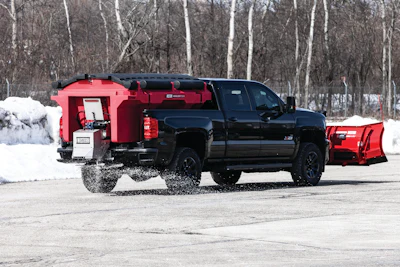
Before you hit the roads or lots with your spreader, make sure it’s operating correctly. Calibration helps deliver the right amount of material consistently across different products, weather conditions, and surfaces.
Testing and adjusting settings up front reduces over- and under-application, protects surfaces, and improves performance consistency across operators and storms.
Why Should You Calibrate?
In order to price your services correctly, you need to know how much material you are using. On average, contractors put down about 3 to 5 times more salt than needed, because many operators can’t accurately estimate or consistently apply the appropriate spread rate.
Adding too much salt will not melt ice faster and can lead to more issues. Ultimately, you’re applying excess material that adds no value to the customer, and it raises your cost of servicing. Excess material will also require more return trips to cover the same route, wasting fuel and, most importantly, time. Save material and calibrate your spreader at the beginning of the season to set yourself up for success.
 Western Products
To begin the calibration process, you need to experiment and test your equipment. For best results, each spreader should be calibrated, especially if they are different makes, models, and sizes. Calibration is figuring out the pounds per second your chain or auger delivery system is distributing at each material flow setting.
Calculating Application Rate
This process should be completed one setting at a time, from start to finish. Repeat the same steps for each setting you plan to use.
Start by detaching the spinner. Select a single conveyor or auger setting and run the spreader for 10 seconds, allowing material to flow into a tub or container.
Next, weigh the collected material to determine output for that specific setting. For example, if the material weighs 16 pounds after 10 seconds, divide 16 by 10 to calculate the flow rate per second. In this case, the material flow rate equals 1.6 pounds per second. Record this number, then repeat the process for the next setting. If you test and weigh all the hopper spread rate settings, you will be able to determine the corresponding spread rate for each setting.
User Variables
- (X) Spread Pattern Width = ____ft (8 to 40ft)
- (Y) Vehicle Speed = ____mph
- (Z) Material Flow = ____lbs/s (0.5 to 3.9 lbs/s)
Conversion Factors
- (A) Distance = 5,280 SqFt/Mile
- (B) Time = 0.01667 hr/min
- (C) Area = 43,560 SqFt/Acre
- (D) Time = 60 s/min
Calculations
- (E) Spread Coverage = X * Y * A * B = ____ SqFt/Min
- (F) Spread Coverage = C / E = ____ min/Acre
- Spread Coverage Rate = Z * D * F = ____ Lb/Acre
Depending on the results, create a reference card for each spreader that reflects the correct material width, material flow, and vehicle speed based on different weather conditions.
This is a starting point for your operators. Based on different materials and unique storm conditions, you can adjust as needed.
 Western Products
There Isn’t One Single Solution
Storms are unpredictable, and each one brings its own challenges. Preparing early by calibrating and testing your hopper settings ensures you’ll be ready when the snow arrives.
Tip: Application rates will vary with the material you use. Salt and other chlorides are used in lower application rates, generally less than 500 pounds per acre, to melt or prevent ice. Sand is used to provide traction and is applied at much higher application rates, generally over 1,000 pounds per acre. Additional best practices can be found at SIMA.org.
 Western Products
Advantages of Pre-wet Salt
Different de-icing materials can be better for certain situations. Using pre-wet salt has several benefits that allow it to work better and faster in extreme cold temperatures. Pre-wetting salt “activates” the material to accelerate ice melting, and the pre-wet granules bounce less when hitting the pavement for greater control and less waste. Studies have also proven that application rates can be reduced by up to 30% when pre-wetting salt with liquids.
Finding Local Guidance
State transportation departments and local agencies often provide valuable recommendations for winter maintenance, including guidance on proper application rates. Taking advantage of these resources can help you fine-tune your calibration, stay compliant with regulations, and make more informed decisions for efficient, effective snow and ice management.