A strategic machine like a small articulated loader (SAL) can keep crews busy all year long. However, it’s easy to make purchase decisions based on a spec sheet and overlook intangible benefits that maximize productivity and build business as seasons change. By focusing on a few key considerations during the purchasing process, the right SAL can successfully go from landscaping and tree care to snow removal with ease.
Here are five design aspects to consider when choosing an SAL that needs to perform effectively and efficiently in both sun and snow.
Size
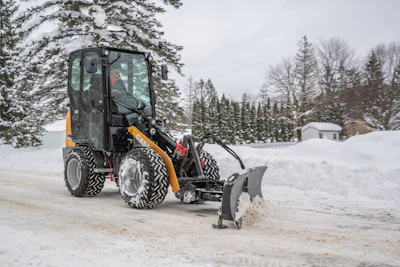
For residential jobs, a small frame (typically under 2,500 lbs.), narrow working width and small tires are an ideal fit for all-season use. This model size lets operators travel through backyards for landscaping and along sidewalks for snow removal.
For commercial use or regions that experience heavy, dense snowfall, operators will want all the above plus at least one auxiliary hydraulic option such as a tandem pump that dedicates flow to a hydraulic attachment. Preventing parasitic loss from the transmission or hydrostatic drive helps ensure there’s continual power to the broom or the snowblower.
While there are advantages to having an open canopy model during warmer months, a cab is essential to protect operators from the elements in colder temperatures. In addition to the enclosure itself, cabs typically come with a heater to keep operators comfortable and alert. They should be equipped with lights, strobes and windshield wipers to improve visibility and safety in snowy and nighttime conditions.
 The CII coupler on the CASE SL15 can universally connect to any brand’s attachments, while optional continuous flow hydraulics help ensure attachments maintain consistent power.CASE Construction Equipment
Operator Position
In SAL designs, the operator is stationed either in the center or rear of the machine. The location significantly affects maneuverability and visibility, which make a big difference for operator confidence and capability.
In a center-mounted cab, the operator has minimal visibility to the sides and the rear of the machine and a wider turn radius. An operator can’t turn too close to obstacles, otherwise the cab will swing outward and make contact.
In comparison, a rear position and front articulation allow for a larger cab size, offer greater visibility to the entire machine and achieve a tighter turn radius, which lets operators work alongside walls. It also provides a counterweight to balance the machine when lifting heavy dirt or snow, and its flatter deck makes it easier to enter and exit the machine, especially in snow and ice.
For owner operators, a rear operator design makes serviceability much faster as it’s easier to get to the engine compartment, hydraulics and cooling fan.
Control Layout
When evaluating SALs for any job, it’s important to look for controls that prioritize ease of accessibility and use. Key controls — the joystick and hydraulic switches — located in the operator’s field of vision lets them focus on the task at hand. In some instances, the auxiliary hydraulics are controlled via a press-and-hold trigger on the joystick that allows the operator to control hydraulics and machine movement with one hand vs. models with a lever in the control panel that an operator must locate and remove their hand from the joystick to activate.
Additionally, a simple drive function with forward, neutral and reverse buttons on the joystick and a single throttle pedal is similar to automotive styles and can shorten the learning curve for new operators and simplify operation for seasoned ones. This is in comparison to designs that are like a hydrostatic tractor with two directional pedals on the floor, which can be hard to distinguish in slippery winter boots.
 Oscillation allows the front section of an SAL to pivot while in motion, offering operators a smoother ride and keeping attachments like a V-plow level with the ground. CASE Construction Equipment
Oscillation & Oscillation Lock Out
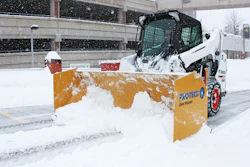
Oscillation allows the front section of the SAL to pivot while in motion, absorbing shock and stabilizing the machine. All four tires maintain contact with the ground, giving the machine better traction. This offers operators a smoother ride and prevents attachments and loads from shifting, which is key for snow removal. If an operator uses a V-plow or a small snow blade while driving over drifts in an SAL with oscillation, the attachment maintains level, continuous contact with the ground.
If a rigid frame goes over a curb or rock, the front wheel lifts, and the machine loses traction. This can put too much pressure on one side of a ground-level attachment and damage it.
That said, some work does require the need for a rigid frame so the ability to turn oscillation off is useful. For example, all CASE SAL models have an oscillation lockout option allowing operators to stabilize the frame while performing flat groundwork and high lifting tasks common to landscaping and tree care.
Attachment Capabilities
An SAL’s attachment capability may be the biggest factor in the range of jobs it can perform. To have the greatest versatility, look for a model with a common industry interface (CII) coupler that can universally connect to any brand’s attachments. Proprietary coupler designs limit crews to a single brand’s offering. This can be especially advantageous if a contractor has already invested in attachments and purchases a new machine that's a different brand. With a CII coupler, they don’t have to replace the attachments as well.
Thrive in Every Season
The right SAL has the versatility, functionality and power to go from landscaping jobs to snow removal with ease. By considering key features and functionality, contractors can select a dual-purpose machine to extend business into the wintertime. Look for a dealer that offers demos to get critical in-cab insight before committing to a purchase. It’s often the intangible benefits — maneuverability, visibility and comfort — that make the biggest difference and offer the greatest advantage.