
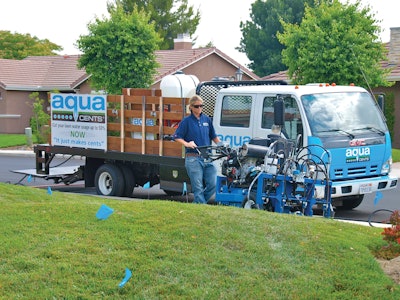
Water conservation is a big deal in places like California. In fact, it's becoming a big deal in municipalities all across the country. Tom DeLany, co-owner of Fresno-based All Commercial Landscape Service Inc. (ACLS), has developed a new service that speaks directly to this issue.
ACLS was profiled in the October 2011 issue of Green Industry PRO. At that time, DeLany said his company's Certified Water Consulting division was helping create some competitive separation. Now, its new AquaCents service is helping create even more.
DeLany came up with the idea for AquaCents in summer 2010. "While doing installations for a developer, we were trying out this product called Stockosorb, a cross-linked polymer granule capable of retaining up to 400 times its weight in water," DeLany tells. "We used a belly-grind fertilizer spreader to apply the sponge-like granules, hand raked them into the soil, and then applied the sod on top."
These newly installed lawns required about 50% less water, according to DeLany, but were also knitting much better than lawns where the polymer granules weren't utilized. "The benefits were clear," DeLany says.
The only problem was that, due to economic conditions, ACLS was not installing many new lawns in 2010-2011. Thus, DeLany wanted to figure out a way to utilize these water-absorbing polymers in existing lawns. That would mean finding a way to inject them deep into the soil below the plant roots.
The polymer-injecting process is the key
"I had one of those middle-of-the-night ideas," DeLany relates. He contacted Andros Engineering, a well-known manufacturer of harvesting and irrigation equipment for the ag industry, based in Paso Robles, CA.
"The first thing we came up with was basically a pressure washer with a single probe," DeLany says. The probe had four orifices on the tip. "You cranked your foot on the machine's pedal to manually inject the granules into the ground. We used this for field tests at Fresno State. Results showed 38% water savings. So we knew we were onto something."
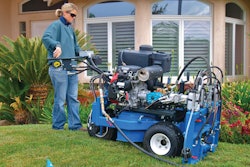
DeLany and his co-inventors at Andros Engineering also knew they had to make improvements in the way of productivity. Now onto the fourth generation of the machine, they definitely have. This latest machine is computer-driven, features four probes with eight orifices each, and injects at 3,000 pounds of pressure as compared to just 1,000.
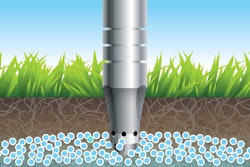
The new machine also maintains its pressure throughout an entire injection. "Our first prototype would burst at 1,000 pounds, but trail off to around 200 in a micro-second," DeLany explains. "The new machine stays in the 2,500- to 3,000-pound range throughout the entire injection cycle. That leads to a consistent dispersion of polymer material roughly two to six inches below grade. That's important because you want to get an inch or more below the root zone in order to develop roots and get them down to the water bar."
How the AquaCents machine works
Tom Klippenstein of Andros Engineering is one of the co-inventors of the AquaCents machine. He provides a quick rundown of how the machine works.
From a system standpoint:
- The polymer granule/water slurry is stored in a large tank that stays with the transport vehicle.
- A “nurse” pump located at the tank pushes the polymer through a hose to the polymer-injector machine at low pressure.
- The polymer injector machine then pressurizes the slurry to extremely high pressure and sprays it out of probes below the turf laterally.
- The injection sequence is: probes are in the up position while the machine moves … with the machine stationary, the probes move down to a set depth … the highly pressurized polymer sprays out of the probes … the probes move to the up position and the cycle repeats.
- A series of hydraulic valves control the movement of the machine and movement of the probes.
- A small computer takes inputs from both the operator and machine, and sequences the hydraulic valves.
From an operator standpoint:
- The operator sets the injection depth by turning a handle.
- The operator then selects manual or automatic mode.
- In manual mode the operator moves the machine into position and pushes a button to run a single injection cycle. The operator is fully in charge of positioning and injecting in manual mode.
- In automatic mode the operator simply selects the desired spacing between injections on a dial and sets the drive speed with a lever. The machine then moves the set distance, runs an injection cycle, moves the set distance again, injects … and the cycle repeats. The operator still has to guide the machine, but the machine is measuring and injecting automatically.
"The operator can be trained on the machine's operation very quickly," Klippenstein assures. "No special skills are required to operate it."
Other noteworthy items regarding the AquaCents injector machine include:
- 20-hp engine powers the high-pressure polymer pump
- Drive system and probes are hydraulically powered
- Weight is similar to a commercial riding mower
- Service/maintenance issues similar to other engine-powered equipment; i.e. routine oil changes – however, the polymer/water slurry must be flushed out of the system prior to prolonged storage.
AquaCents has come a long way since ACLS crews first hand raked those polymer granules into the soil back in 2010. The first-generation AquaCents injector machine then allowed a single operator to take care of an average-sized residential lawn in about a day. Today's machine only takes about an hour.
Results have improved as well. "Trials are now showing water savings up to 60%, with the average being 40-50%," DeLany says. "We're looking at root systems that are three or four times more fibrous than they were nine months earlier."
For now, ACLS Inc. will continue offering AquaCents as a service to its own customer base. But DeLany sees it as a service just about any landscape contractor could offer—especially those with customers who are concerned about rapidly climbing water rates.
According to DeLany, closing sales comes down to explaining the numbers. "For the average homeowner, it's a 5:1 ROI over a five-year period," DeLany says. "One injection costs $1,000 and lasts about five years—but you could end up saving $5,000 on your water bills during that time."



![Optimax Sp 0228[1]](https://img.greenindustrypros.com/mindful/acbm/workspaces/default/uploads/2026/05/optimax-sp-02281.lJdm8xL6hQ.jpg?auto=format%2Ccompress&fit=crop&h=100&q=70&w=100)




![Optimax Sp 0228[1]](https://img.greenindustrypros.com/mindful/acbm/workspaces/default/uploads/2026/05/optimax-sp-02281.lJdm8xL6hQ.jpg?ar=16%3A9&auto=format%2Ccompress&dpr=2&fit=crop&h=135&q=70&w=240)


