
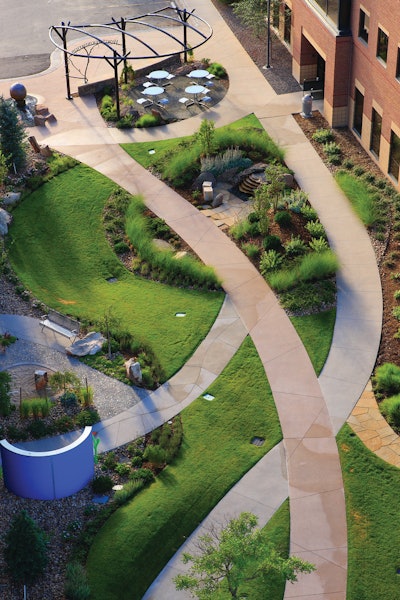
Denver-area Environmental Landworks burst onto the scene in 2007 when co-owner Bill Chevalier was presented with a career-changing opportunity to do a large commercial landscaping job. From that day forward, one job has led to another—to the point where the company has racked up sales of more than $5 million in this its sixth year in business.
Environmental Landworks considers itself a commercial construction company. But over the past couple of years, they've built up a substantial "service" operation (i.e. maintenance and snow removal), and are now establishing a residential design/build division. Chevalier, together with partner Michael Sittaro, say it's all part of an effort to improve the financial health of the company as it enters the second phase of its young existence.
Commercial construction paves the way
Chevalier started out in the Green Industry in 1991. He studied landscape design and construction at Colorado State University and earned a horticulture degree in 1996. He even had his own small landscape company for a short time after graduating. Then he got married, and decided to put having his own company on the back burner. Chevalier went to work for another landscape firm. This is where he developed a love for commercial construction.
In time, Chevalier took a new job with another large landscape company in the Denver area. "I networked like crazy," he relates. "My goal was always to learn as much as possible so I could start another company of my own. An amazing opportunity came up with a developer in 2007. I was a bit hesitant, but it was a once-in-a-lifetime chance I couldn't pass up."
Although Environmental Landworks has since branched into both maintenance and residential design/build, commercial construction still accounts for roughly half of the company's overall revenue. Chevalier likes to refer to it as the company's lead blocker.
"Commercial construction opens up holes for us to run through," Chevalier says while sticking with the football metaphor. "The margins are tight. But with the dollar volume it generates, it helps us absorb a lot of liability. Our commercial construction division alone allows us to recover the majority of our overhead, including our trucks and equipment."
Commercial construction also helps establish a level of comfort among staff. "We've never had a mass layoff in the six years we've been in business," Chevalier points out. "If we retained employees for four or five months, and then let them go for the rest of the year, we'd have a hard time getting them back. So we have an annual staff meeting at the end of each season. We look at our backlog of work and projected man-hours, and then leave it up to them. Do we want to lay some guys off, or do we want to divide those projected man-hours equally so we can keep everybody? Our crew members might be cut back to 20 hours a week for the off-season. But they're usually OK with that. This is what seems to work best for us, as well."
Two keys to standing out in commercial
Chevalier says he's heard some refer to Environmental Landworks as a "boutique" landscape company. Not because the company is small or niche, but because it's sophisticated. "We're willing to take on more challenging, time-sensitive projects that are more integrated with an overall construction project," Chevalier says.
Two things have helped Environmental Landworks establish a strong reputation in this regard: close collaboration with architects from the beginning, and "unparalleled" pre-construction services.
"We always try to make sure an architect knows that we will not mess with the integrity or intent of their design," Chevalier says. "We want to work hand in hand to solve problems. There can be no finger pointing."
Grading issues are a good example. Sometimes there's a slight miscalculation on a plan—which can result in several additional cubic yards of dirt that need to be hauled away. "We get together with the architect to discuss our options," Chevalier says. "We try to move some things around and massage the grades so we won't have to export as much material."
Pre-construction services represent one of the biggest feathers in Environmental Landworks’ hat. Fred McAfoos, with more than 40 years experience, spearheads this effort. "Fred works closely with the architect so the architect doesn't over-bid," Chevalier explains. "For example, if a client says they don't want to drop a single penny over $200,000 on the landscape, we need to find a way to make that happen. So we might have to downsize certain elements or eliminate an extra, like a water feature, for example."
Bringing maintenance in house
As the company's lead blocker, commercial construction has opened up one particularly sizable hole: a foray into commercial maintenance. In its first year in business, there wasn't a single mower in Environmental Landworks' equipment fleet. "We actually bid out maintenance to our competitors because we didn’t own a mower, and really didn't want to," Chevalier recalls. It's a different story today, however.
A couple of years ago, Chevalier and Sittaro began the process of bringing maintenance in house. Initially, their construction crews started doing irrigation system maintenance and landscape maintenance. Today, maintenance and snow removal is its own fully staffed division—generating nearly $2 million a year depending on snowfall.
Like commercial construction, commercial maintenance is highly competitive. The margins are tight, too, and have gotten even tighter. Chevalier says, "You can't eliminate this challenge, because every day there's a lowballer coming after just about every job we have. We need to make sure we don't open the door for them to take work from us. That simply comes down to quality and communication."
Environmental Landworks does offer full-service maintenance, but relies on subcontractors for some of it.
As far as tree work goes, Environmental Landworks handles "anything they can get from the ground," but subcontracts the more intense work. They also subcontract plant health care. "We have a great relationship with a company that specializes in tree and turf care," Chevalier points out. This company actually emerged just a few years before Environmental Landworks came to be. Chevalier knew the key people from having worked side by side with them at other companies.
"We've tried doing lawn care (chemical and organic applications) ourselves, but it makes more sense for us to outsource it," Chevalier relates. "We just can't match the efficiency of this other company. Plus, we don't need to worry about licenses or storing the materials. Subcontracting actually reduces our costs by 30%, so we will stick with this approach for now."
Quickly establishing a residential presence
Environmental Landworks' latest initiative has been an expansion into the residential design/build arena. Chevalier says the opportunities in this market aren't as plentiful as several years ago, but the opportunities that do exist are lucrative.
"We've been successful with renovations and new constructions for large HOAs," Chevalier says. "My goal is to have patience and a strong desire to educate. That's why we're proactive in communicating with not only the board president, for example, but also the homeowners themselves. We regularly send bulletins to every single member."
This tactic has led to additional opportunities. They aren't necessarily huge projects, but they add up. "A homeowner within a large HOA might ask us to do an irrigation system upgrade or install a paver patio on their property," Chevalier says. "We have our maintenance crews handle these jobs.”
Environmental Landworks has also begun targeting the single-family estate market. Thus far, roughly 20% of the projects are tied to new home construction—not to mention the relationships Chevalier and Sittaro have with area builders. The other 80% are what Chevalier likes to refer to as, “scrape and start over.” Very little advertising is done, as virtually all projects are derived from word of mouth.
Now the company sees a growing need for estate maintenance. Like in the commercial arena, competition is hot. “I might bid a property at $125 a week, but we’re getting undercut by more than half,” Chevalier says. “But it’s usually a small crew with an old truck that’s bidding against us. So for us it’s about image and knowledge. There’s a fine line between regular residential maintenance and estate maintenance. We want to help make that line a little bit clearer through the way we operate.”
Now completing their sixth year in business, Chevalier and Sittaro are quite happy with how their company operates. They’re also happy with how their partnership has flourished.
“We understand each other’s strengths, weaknesses, goals and expectations,” Chevalier says. “One word that describes us is ‘passion.’ We’ve gone through a lot for our employees and customers. But we wouldn’t trade it for the world. We are so grateful for this opportunity.” It’s an opportunity Chevalier is sure glad he didn’t pass up back in 2007.







![Optimax Sp 0228[1]](https://img.greenindustrypros.com/mindful/acbm/workspaces/default/uploads/2026/05/optimax-sp-02281.lJdm8xL6hQ.jpg?ar=16%3A9&auto=format%2Ccompress&dpr=2&fit=crop&h=135&q=70&w=240)


