
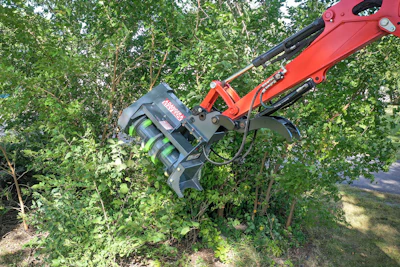
Mulching heads are powerful tools designed to tackle dense, challenging vegetation. Watching these attachments reduce large trees into fine material makes it easy to see why safety must always come first. Because of the forces involved, operators need to fully understand proper procedures to avoid injury, prevent equipment damage and reduce other potential hazards.
The following guidelines highlight key safety considerations to help operators stay protected while getting the job done efficiently.
Know Your Machine
Safe operation begins with a thorough understanding of the equipment. This means carefully reading and following the owner’s manuals for both the mulching attachment and the power unit. This step is not optional — every individual who operates the equipment must be familiar with these instructions.
Operators should also understand the capabilities and limitations of the machine. This information is outlined in the manuals and should be followed closely. For example, if a skid steer has a maximum hydraulic relief pressure of 3,500 PSI, a good operating practice is to stay around 3,000 PSI. A general rule of thumb is to operate about 500 PSI below the maximum rating. Many mulching heads are equipped with pressure gauges that help monitor performance. Running equipment at or near its limits for long periods can cause overheating, which increases the risk of fire and can lead to costly damage.
For skid steer and compact track loader operators, knowing how to exit the machine in an emergency is also critical. Operators should be familiar with the location and use of the emergency exit. This knowledge can be vital in the event of a fire or if the loader arms block the main door, allowing the operator to exit safely.
 Loftness
Create a Safe Work Area
One of the most important safety rules when using mulching attachments is keeping bystanders away from the worksite. Many manufacturers recommend maintaining a safety zone of at least 300 ft. from the operating mulching head. This distance is especially important when using disc mulchers, which tend to throw debris farther than drum-style mulchers.
Before starting work, inspect the area and remove foreign objects such as wire, rocks and bottles. Wire can become entangled around the rotor and create dangerous conditions. Solid objects may damage the attachment or be thrown at high speeds, posing serious risks.
Ground conditions should also be evaluated before operating. Identify steep slopes, culverts and other obstacles, and approach them carefully or avoid them altogether. Paying attention to terrain can help prevent rollovers, tipping incidents and other dangerous situations.
Use the Right Protective Equipment
To safely operate a mulching head, the power unit — whether a skid steer, excavator or another carrier — must be fitted with impact-resistant guarding. A polycarbonate door is essential, as standard glass doors can shatter when struck by debris, putting the operator at risk.
Even with proper machine guarding in place, operators should wear safety glasses and appropriate personal protective equipment. This provides an additional layer of protection in the unlikely event that the shatter-resistant door fails.
Operators should also inspect the cutting teeth regularly. Any cracked or damaged teeth should be replaced immediately. If a tooth fails during operation, fragments can break loose and become dangerous projectiles.
Cleaning the equipment before operation is another critical step. Remove any built-up debris from around the engine, exhaust and other crevices. As the machine heats up, accumulated material can ignite and cause a fire.
Operate With Caution
During operation, always remain aware of where debris is being discharged. Position the attachment so material is directed toward the ground, but not so far downward that the cutting teeth are visible from the cab. When the teeth are exposed in this way, debris can be thrown directly toward the machine, potentially damaging the cab or injuring the operator if the door is compromised.
Wire wrapped around the rotor presents another serious hazard. Some operators attempt to continue running the machine until the wire clears itself, but this is unsafe. Wire can break apart and fly off at high speeds, acting like shrapnel that may puncture the cab door and cause severe injuries. The safest approach is to shut down the machine and remove the wire manually before resuming work.
Anytime the machine is stopped to clear debris, remove wire or perform maintenance, proper shutdown procedures must be followed. Disengage the attachment, turn off the engine and remove the key. Never perform maintenance on a mulching head while the power unit is running. If working underneath the attachment, ensure it is securely blocked. When servicing cutting teeth, stabilize the rotor to prevent unintended movement.
The owner’s manuals for both the mulching attachment and the power unit contain additional safety information and should always be referenced. By following these fundamental guidelines, operators can reduce risk, protect their equipment and ensure a safer, more productive mulching operation.







![Drum Mulcher Od Pro X 7 67cb491a64072[1]](https://img.greenindustrypros.com/mindful/acbm/workspaces/default/uploads/2026/02/drum-mulcher-od-pro-x-767cb491a640721.02UXvec6nZ.png?ar=16%3A9&auto=format%2Ccompress&dpr=2&fit=crop&h=135&q=70&w=240)

