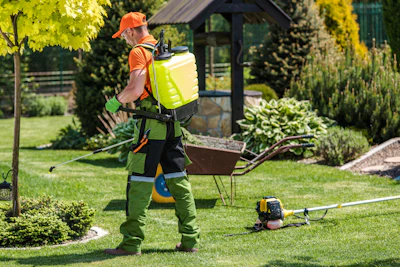
Weed management has always been one of the most persistent challenges facing landscaping professionals. Whether maintaining commercial properties, municipal parks, athletic facilities, or residential landscapes, controlling unwanted vegetation is critical to preserving both appearance and functionality.
Eliminating the weeds themselves is just one small part of the picture. Regulatory changes and growing public interest in sustainable landscaping practices are changing how we think about the relationship between weed management and our broader environment. Clients want weeds gone, but they want them controlled in a way that relies less on conventional herbicides.
As a result, landscaping professionals face a wide variety of challenges and considerations that continually reshape practices. In an effort to balance efficiency and effectiveness while navigating labor constraints and evolving customer expectations, they are taking on a more multifaceted approach than ever. Though there’s no universal, definitive approach that accounts for every scenario, there are a number of general best practices that can be adapted to suit the particularities of each local setting.
Why Traditional Weed Control is Becoming More Challenging
Although conventional herbicides have long played a central role in landscape maintenance programs, recent regulatory and cultural shifts are causing a gradual movement to restrict their usage, both in North America and throughout the world. Municipalities, school districts, healthcare facilities, and other organizations often have very stringent criteria about the products that can be used on their property.
It’s not just larger organizations, however. Concerns about conventional herbicides have become more mainstream due to information circulating on social media and other news sources, making sustainability a greater concern among commercial property owners and individual citizens as well. The broader trend towards sustainability has also influenced government policy at both the federal and state levels.
On top of all of this, many companies continue to struggle with ongoing labor shortages. Manual weed removal remains effective in many settings, but rising labor costs and workforce challenges can quickly put strain on landscaping companies’ time and resources. Finding strategies that maintain compliance without sacrificing performance or overburdening teams is essential for navigating this increasingly multifaceted task.
Broadening the Weed Management Toolbox
Many modern weed control programs emphasize proactive and preventative measures to minimize the need for chemical inputs and manual weed removal. These longer-term strategies include steps like supporting healthy, competitive plant growth to suppress weeds before they can become firmly established. This method involves the careful use of irrigation, as well as targeted fertilizing and mulching to create conditions that are favorable to desirable vegetation while choking out unwanted weeds.
Mechanical controls such as hand-pulling, moving, and edging also remain an important part of the toolbox. Though more labor-intensive than other methods, they are still unparalleled when it comes to highly targeted and specific weed control. Because the kinds of preventative measures outlined above can reduce the overall volume of undesirable growths, they help lessen the burden on professionals in charge of mechanical controls, making the two more effective when used in tandem.
The most effective programs are consistently those that integrate multiple approaches based on site conditions, customer requirements, and operational realities.
Biological and bio-based solutions are other often-underemphasized tools that have become increasingly influential in the industry. These techniques range from grazing animals in particular habitats to using biological products that directly attack undesirable plants. Although their use is very context-dependent, they are a diverse and quickly developing category that landscape experts are increasingly integrating into their practices for both performance and sustainability reasons.
Each of these tools comes with specific strengths and weaknesses. However, combining them with other approaches can help bolster their strengths while compensating for their limitations. As a result, the most effective programs are consistently those that integrate multiple approaches based on site conditions, customer requirements, and operational realities.  Contact BioSolutions
The Role of Bioherbicides
As a consequence of the growing interest in alternative weed-management methods, bioherbicides have become an increasingly common topic of conversation in the landscaping business and beyond.
Bioherbicides are weed-control products derived from naturally occurring biological materials or processes. Using everything from bacteria and fungi to natural enzymes, these tools can break down weeds on contact and allow them to be reabsorbed into the soil while leaving minimal residue behind. They are becoming increasingly popular for their ability to target weeds that have developed resistances to synthetic herbicides.
However, one common misconception many non-users have is that bioherbicides should be treated as direct, one-to-one replacements for every conventional herbicide application. In practice, they are often most effective when used in a highly targeted manner that complements existing weed prevention and control practices. They are especially well-adapted to environmentally sensitive areas and heavily regulated environments, which has been a major factor in increasing their popularity.
Handling Customer Expectations
As sustainable weed management becomes more of a widespread public concern, clients are more interested than ever in understanding exactly what products and techniques are being used. Today’s weed management teams not only need to execute their programs effectively, but also have the ability to explain them to clients and stakeholders in order to show proof of concept.
Trust and transparency will ultimately be what separates the companies that deliver a truly modern customer experience from those that lag behind.
For this reason, it is more important than ever for landscaping professionals to know the ins and outs of each product and technique that they choose to use. Discussing treatment plans with clients and educating them on integrated management programs can help landscaping companies manage clients’ expectations while also building trust and strengthening long-term relationships. This degree of trust and transparency will ultimately be what separates the companies that deliver a truly modern customer experience from those that lag behind.
The future of weed management will not be defined by any one product or technique. Instead, it will be shaped by the industry’s capacity to creatively apply both old and new tools to manage ever more complicated demands.
Landscape professionals who implement diversified weed management tactics will be better positioned to respond to regulatory changes, satisfy changing consumer demands, and remain operationally efficient.