Landscaping has always been defined by one constraint: how reliably a team can deliver consistent results — profitably and at scale — within limited time and labor. For decades, the industry improved through better equipment and better processes.
Today, something more fundamental is changing. The most important question is no longer only what powers the equipment, but how work is executed — and how much of it depends on continuous physical operation.
Over the past seventy years, landscaping has progressed through three shifts:
- Mechanization in the mid-20th century multiplied what a worker could accomplish in a day and helped establish the modern contractor model.
- Electrification and smarter equipment from the 1990s through the 2010s improved usability and working conditions, but the operating model stayed largely the same: someone still had to be present and actively operating each machine.
- Automation and robotics, now emerging, introduce a different kind of efficiency—systems designed to deliver routine work with consistency without requiring continuous human presence, while remaining under human direction and oversight.
This is why the framing is changing. Historically, the industry has talked about equipment in categories like gas versus electric. That lens matters, but it assumes the same foundation: the work happens only when a person is physically operating the machine. A more consequential distinction is becoming human-operated equipment versus human-directed autonomy — systems that execute within boundaries people set, with control rights that remain with people.
Why Robotics Now: The Structural Pressures Reshaping the Green Industry
In the United States, the green industry is reaching a point where productivity can no longer be improved only by working harder or upgrading individual tools. The constraint has become structural: how to deliver predictable, professional outcomes at scale when labor, time, and operating complexity are tightening at once.  The S4Sunseeker
For landscapers, this challenge is felt every day. Grounds maintenance is a major employment category in the U.S., with Landscaping and Groundskeeping Workers numbering 943,430, according to the Bureau of Labor Statistics (May 2024) in the latest Bureau of Labor Statistics occupational data. Yet availability and reliability of crews remain persistent constraints on growth. When headcount is tight, consistency becomes harder to protect—and much of a typical schedule is still anchored in repetitive mowing: essential work, but difficult to scale without adding people. The operational equation is familiar: margins get squeezed, growth slows, and teams spend more energy keeping up than moving forward.
For dealers, pressure shows up differently but points to the same shift. Traditional equipment cycles can be seasonal and price-sensitive, while customer expectations are moving toward solutions that are easier to adopt and sustain. More dealers are looking for categories that support deeper service relationships—installation, maintenance programs, and seasonal servicing — rather than relying primarily on one-time transactions.
For property owners and end users, priorities are evolving in parallel. Noise and emissions are becoming more visible considerations in neighborhoods and public spaces. At the same time, expectations for clean, consistent outcomes are rising. The bar is moving from “good enough” to “predictably professional.”
Given these pressures, a reasonable question follows: if the demand for productivity is so clear, why hasn’t robotic mowing already become mainstream in the U.S.? The short answer is that, for a long time, robotics did not meet professional requirements. Performance was hard to trust across the types of sites that define the U.S. market — large acreages, complex boundaries, multi-zone properties, slopes, and mixed-use environments. For professionals, “almost reliable” is still unreliable.
The Technology Inflection Point: How AI and Robotics Unlock the Next Efficiency Curve
What has changed is not that robotics has become more ambitious, but that the technology stack has matured enough to make performance predictable — and predictability is what turns a concept into an operational tool.
The first breakthrough is high-fidelity environmental perception. Leading systems increasingly fuse LiDAR, AI vision and RTK-grade positioning with complementary sensors to build a more resilient understanding of outdoor environments. At the category’s leading edge, the sensor suite can now reach configurations featuring a system of sensor to support fuller-scene perception and more robust obstacle handling.
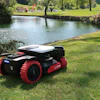
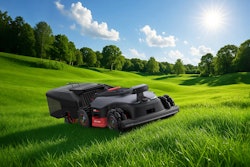
 The Sunseeker Elite X9 Series includes 16 sensors (including 8 cameras) and a 360-degree OmniSight 24h Full Scene System — illustrating how perception is being engineered for real outdoor variability rather than ideal conditions. Its 10 TOPS AI chip support responsiveness and obstacle avoidance, alongside an RTK-and-VSLAM fusion approach (AONavi) aimed at improving boundary-setting and route planning resilience.Sunseeker
The second breakthrough is that intelligence is moving from basic automation to adaptive execution. With stronger onboard computing and smarter planning, robotic mowers can sustain more stable coverage, handle multi-zone properties more reliably, and apply consistent strategies across irregular layouts.
The third breakthrough is terrain readiness, especially critical in the U.S. market. Slopes, uneven ground, and large-acreage properties are common, which makes traction and stability foundational — not optional. The direction of the category is toward stronger drive and mobility systems.
Just as important, the efficiency curve opens when robotics becomes operable at scale. The industry is moving beyond single-machine use toward coordinated operations: fleet management, remote monitoring, multi-unit scheduling, and diagnostics that reduce downtime.
Operational enablers such as faster charging and OTA updates can further expand usable windows and reduce service friction.
A neutral view is essential. Autonomy does not eliminate the need for people. High-traffic areas, unusual edge cases, and extreme terrain still benefit from human judgment and oversight. But those boundaries are not static: software iteration, data-driven learning, and OTA updates continue to push reliability forward in measurable stages — while keeping goals, constraints, and exceptions firmly under human control.
 The X9 Series emphasizes an ATC Pro Drive System with 4WD/suspension elements as part of its terrain capability narrative. Sunseeker
Building a Human–Robot Partnership for a More Resilient Landscape Workforce
Debates around automation often focus on replacement. In landscaping, the more important shift is reallocation.
Robotics is changing not the need for people, but where human effort creates the most value. When repetitive mowing is handled consistently by machines, human crews can focus on judgment-intensive work: finishing details, site-specific adjustments, landscape design, irrigation management, and customer relationships.
This matters because the industry’s long-term constraint is workforce resilience. A model that relies exclusively on physical repetition is difficult to sustain under labor scarcity and rising expectations. A human–robot partnership allows teams to scale output without scaling fatigue, and to grow operations without proportionally increasing headcount. Crucially, this partnership model depends on clarity of control: people define boundaries, set priorities, and handle exceptions; machines execute within those constraints.
Value Across the Ecosystem: What Automation Ultimately Delivers
When viewed through this lens, the value of automation becomes visible across the ecosystem.
For property owners, it delivers consistent results with less disruption — benefits that align with rising expectations for quality, noise management, and day-to-day reliability.
For landscapers, the impact is structural: automation changes the economics of service delivery, reducing rework and stabilizing operations so the same workforce can manage more properties.
For dealers, the shift expands the role they play as system integrators — supporting installation, configuration, maintenance, and seasonal servicing — creating more durable relationships and revenue models.
Every major efficiency shift in landscaping has changed not just tools, but how work is structured. The third revolution — automation and robotics — is less about replacing people and more about redesigning how human effort is applied. The next decade will not be defined by machines alone, but by how thoughtfully people and machines work together.