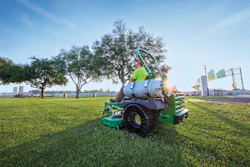
Autonomous mowing equipment is reshaping commercial grounds management, but making a smart investment starts with understanding the technology behind it. Fluency in autonomous mowing terminology is not about jargon; it is about confidence. When buyers understand how these machines navigate, operate safely, collect data and perform in real-world conditions, they can better evaluate what will truly work for their operation and their clients. That knowledge reduces uncertainty, limits risk and supports long-term value.
Demand for autonomous mowers is rising as labor shortages continue across the landscaping industry. Commercial operators are seeking solutions that improve efficiency without compromising quality or safety. Autonomous mowers deliver consistent performance, reduce labor dependence and maintain large areas with precision. Still, not all systems are alike. Understanding key terms that define navigation, safety and performance is essential to choosing the right solution.
Autonomous Mowing
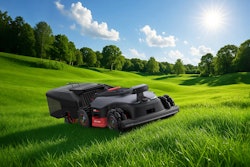
Autonomous mowing refers to the ability of a mower to operate with minimal direct human control. For commercial operators, this means a machine that can travel along its route, detect obstacles, and manage cutting tasks without a person in the seat. Autonomous systems use a combination of sensors, positioning systems, and onboard intelligence to complete mowing cycles independently on defined terrain.
Unlike consumer robotic lawn equipment that remains permanently tied to a single area or docking station, integrated commercial autonomous mowers are designed to work as part of a traditional landscape crew. They are transported from site to site, deployed as needed, and used alongside traditional crews rather than remaining docked at one property for their entire service life.
Understanding this distinction helps buyers set realistic expectations around deployment, supervision, and scalability.
GPS Guidance
Global Positioning System (GPS) guidance is a term you will hear repeatedly when evaluating autonomous equipment. It refers to the use of satellite signals to help the mower determine its location in real time.
In professional equipment, GPS guidance allows the mower to follow preconfigured routes across large, open spaces such as parks, campuses and athletic fields. These systems are typically enhanced with precision technologies that improve accuracy and reduce drift, helping the mower stay on course without constant human steering.
Understanding GPS guidance helps operators see how the mower knows where it is and how it maintains coverage efficiency across expansive properties.
LiDAR
Light Detection and Ranging (LiDAR) uses pulsed laser light to create a detailed, three-dimensional map of a mower’s surroundings.
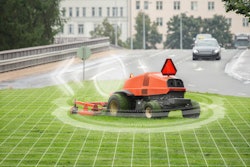
In autonomous mowing equipment, LiDAR sensors continuously scan the environment to detect people, equipment and other obstacles in the machine’s path, allowing the navigation system to slow, stop or reroute to avoid collisions. This 360-degree awareness makes LiDAR especially valuable on jobsites where conditions can change quickly and safety is critical.
But the technology is evolving rapidly. Camera-based safety systems are emerging that enable machines to visually interpret their surroundings in ways similar to human vision. These systems may eventually reduce or replace the need for LiDAR in some applications.
Understanding how LiDAR functions today, and how sensing technologies may evolve, helps buyers assess current capabilities while keeping an eye on the future of autonomous mowing.
RTK Precision
Real-Time Kinematic (RTK) is an advanced GPS technology that dramatically improves positional accuracy. While standard GPS typically identifies location within several meters, RTK refines that position to within one to two centimeters by applying correction data through a cellular connection. This allows autonomous mowers to follow exact paths, maintain consistent coverage and stay on track.
For commercial and municipal customers who require clean, edge-to-edge mowing without retrimming, RTK-level accuracy is essential for efficiency and professional results.
Buyers should also understand how RTK corrections are delivered. Some systems require a local base station installed on-site, while others rely on subscription-based correction services from the manufacturer. Knowing these requirements helps ensure the RTK solution aligns with your jobsite infrastructure and operational needs.
Perimeter Boundaries & Geofencing
Another key concept in autonomous mowing is how the machine determines where it is allowed to operate and where it is not.
Perimeter boundary systems define the limits of the mowing area and guide the mower’s movement within those parameters. Older robotic models often relied on buried boundary wires, which required installation and offered limited flexibility. Modern commercial systems now use GPS-based virtual boundaries or geofencing to define work areas, eliminating the need for physical wires.
Buyers should understand how boundaries are created and how closely an operator must drive or mow along edges during setup. Boundary accuracy affects how efficiently the mower runs and whether it can operate smoothly without stopping repeatedly near curbs, fences or landscaping features. Many platforms also store site plans and boundaries in the cloud, reducing setup time and simplifying repeat visits across multiple locations.
Safety Interlocks & Object Detection
Safety interlocks and object detection describe the protections built into autonomous mowers to prevent accidents.
An object detection system identifies people, animals or unexpected obstacles in the mower’s path and can slow or stop the machine to avoid contact. Safety interlocks are built into the control system so the mower cannot activate blades or move if critical safety conditions are not met.
In commercial landscapes where staff, contractors and the general public may be nearby, these terms matter when comparing brands and capabilities. Be sure you understand a system’s safety features and how they protect workers, operators and site visitors.
Connectivity & Telematics
Connectivity describes how an autonomous mower communicates with operators and management systems. Many commercial mowers are equipped with telematics that transmit data such as location, operating status, errors and job progress to an online dashboard.
These connections may operate through cellular service, Wi-Fi or proprietary radio networks. When evaluating systems, it is important to understand the maximum working distance allowed between the operator and the mower during autonomous operation. Supported ranges vary by platform and can impact how effectively the system performs across different jobsites.
For fleet managers, connectivity enables remote monitoring of one or multiple machines, supporting performance tracking, reporting and client communication.
Operator Oversight
Operator oversight distinguishes between fully autonomous operation and supervised autonomy. Even autonomous systems require an operator to deploy jobs, monitor progress and respond to alerts.
Buyers should understand how much oversight is required during operation and how simple it is for an operator to deploy one or multiple robots at a time. Ease of deployment and monitoring directly affects labor efficiency, training requirements and scalability.
Autonomy does not eliminate responsibility, but clear expectations around oversight help operators plan staffing and workflows more effectively.
Terms Matter
Purchasing autonomous mowing equipment for commercial use should start with a clear understanding of key terms such as autonomous mowing, GPS guidance, LiDAR, RTK precision, virtual boundaries, safety interlocks, connectivity and operator oversight. Each concept represents a specific part of how the machine operates and what it can realistically deliver in the field.
When buyers understand the language behind the technology, they can better compare systems and select solutions that align with their operational needs and business goals. That knowledge turns a complex equipment purchase into a confident investment that improves efficiency, supports safety and delivers measurable value.




![Gravely Pro Turn Mach One My23 Dsc03139 Edit 1200x800 5b2df79[1]](https://img.greenindustrypros.com/mindful/acbm/workspaces/default/uploads/2025/10/gravely-pro-turn-mach-one-my23-dsc03139-edit-1200x800-5b2df791.BucBnDoN22.jpg?auto=format%2Ccompress&fit=crop&h=167&q=70&w=250)