A compact tractor is a versatile tool. With the right attachments, you can move materials, clear brush, handle logs, maintain your property, load trailers, and tackle many other tasks with just one machine.
You lose that versatility if the attachment on your tractor is too heavy. It’s easy to think that heavier attachments are better. More steel looks stronger, and if an attachment fits your loader, you might assume your tractor can handle it. That is not always the case.
Every pound in an attachment is extra weight your loader has to carry before you even start work. That’s why attachment weight should be one of the first things you think about.
Start With the Loader, Not Just Horsepower
People often focus on horsepower when comparing tractors, but horsepower doesn’t tell you how much weight the front loader can safely handle.
When choosing loader-mounted attachments, always check the specifications for your tractor and loader together. Two compact tractors with the same horsepower can have very different loader capacities. Lift capacity also changes depending on where and how high you lift, so a single number doesn’t tell the whole story.
Always start by checking your tractor and loader manuals. Once you know what your loader can handle, you can start looking at attachments.
Your goal should be to choose an attachment that’s right for the job, not just the biggest one your loader can connect to.
The Attachment Is Already Using Capacity
If you put an attachment that weighs several hundred pounds on your tractor, the loader is already carrying that weight before you even pick up anything else.
Now add the material you actually want to move. That’s why choosing the right attachment matters. If it’s too heavy, you’ll have much less capacity left for the actual work you want to do. But the lightest attachment isn’t always the best choice either. It still needs to be strong enough for the job.
A better question is whether the attachment’s weight actually serves a purpose.
A well-designed attachment adds material and reinforcement only where it’s needed, instead of just adding steel everywhere.
Heavy Duty Doesn't Have to Mean Heavy Everywhere
People are drawn to the term "heavy duty," but it has no set definition.
Some jobs require heavier construction. An attachment designed for large logs, rocks, or demanding commercial work needs more structure than one designed primarily for brush and property cleanup.
But just adding more weight doesn’t always make an attachment better.
Stress usually builds up around mounting points, pivots, cylinder mounts, and other structural spots. Reinforcing these areas gives strength without making every part heavier.
Balance matters with compact tractors because available loader capacity is limited.
Your goal should be to choose an attachment that’s right for the job, not just the biggest one your loader can connect to.
Match the Attachment to the Work
Before buying an attachment, think about the jobs you actually do with your tractor. If you spend most of your time cleaning up brush, limbs, and storm debris, your needs will differ from someone moving large logs or heavy timber. The same is true with forks, buckets, and grading attachments.
A lot of people buy for the toughest job they might someday run into. That can leave them hauling around more attachment weight than they need for the other 90 percent of the work.
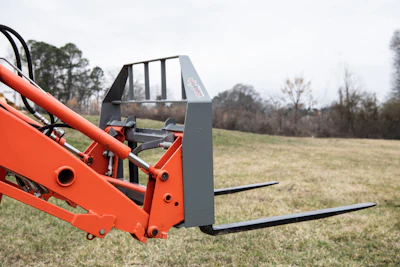
If you mainly move pallets, for example, every extra pound in the fork frame is a pound you are not using for the load. If you mainly clear brush, a grapple built for that kind of work may make more sense than a much heavier model designed for jobs your tractor rarely sees.
Start with the work you do most often, then choose the attachment around that.
Loader capacity should not be treated as a simple "this tractor can lift this many pounds" number — the load's shape and position matter too.
Remember, Loads Move Away From the Tractor
Loader capacity also changes depending on where you carry the load. The farther the weight sticks out in front of the loader, the more leverage it puts on your tractor. Not to mention, that this also changes how the whole machine handles. This is important with grapples and pallet forks, since the material can stick out well past the loader’s usual pivot points.
A tractor that easily lifts a compact load close to the attachment might act very differently with a long log, a big bundle of brush, or a pallet of sod that’s farther out front. Loader capacity should not be treated as a simple "this tractor can lift this many pounds" number — the load's shape and position matter too.
Rear ballast, tires, the ground you’re on, load position, and load height all affect stability. A load that feels fine on flat ground can feel very different on a slope or rough terrain. Operators should follow the recommendations in the tractor and loader manuals for ballast and operating limits.
It’s also important to keep loads low while moving, since raising the loader raises your tractor’s center of gravity. Just because you can lift something doesn’t mean you should carry it high or move it across rough ground.
What matters isn't how impressive an attachment looks sitting in the yard. It’s how well your tractor and attachment work together.
Hydraulics Must Match the Attachment
Weight isn’t the only factor to consider when checking compatibility. Hydraulic attachments like grapples need a hydraulic circuit to operate them, often through a third-function system.
Before you buy, check the tractor’s hydraulic setup, couplers, and hose requirements. How these hoses are routed matters. They need enough slack to move through the loader’s range without getting pinched, stretched, or caught.
These details might not seem exciting when you’re shopping, but they become important once you start using the attachment.
Productivity Matters More Than Size
For contractors, what matters isn't how impressive an attachment looks sitting in the yard. It’s how well your tractor and attachment work together all day long. When you match the right attachment to your tractor, you can use more of its capacity for real work, not just carrying the attachment itself.
Visibility matters. Ease of connecting and disconnecting matters. Hose placement and maintenance access matter. And of course, weight matters too.
The best attachment is not necessarily the heaviest one a compact tractor can lift. It’s the one that’s strong enough for the job but still leaves as much of your tractor’s capacity as possible for actual work.
That’s the balance you should look for as a compact tractor owner.