Over the years, I’ve talked to a lot of lawn care and snow removal business owners. What I’ve noticed is that the ones running tight operations — good crews, reliable trucks, and happy customers — are usually managing more variables in a single day than most people handle in a week. Most of them are doing it without a dedicated person keeping track of it all.
That's why so many owners put a GPS unit or a dashcam in the truck, hoping to gain more control. In my experience, the ones who still get burned aren't the ones who skipped the technology. They're the ones who bought it, mounted it and never built the habit of checking it. That’s where liability exposure often grows.
The Pie Insurance 2025 State of Workplace Safety Report found that 42 percent of businesses with commercial vehicles reported an auto-related incident in the past year, with an average cost of $5,725 per accident. For a small lawn care and snow removal fleet operating multiple vehicles, the margin for error is thin.
Without Footage, Your Driver's Word is the Whole Defense
The moment one of your trucks is in an accident, footage is either your best asset or your biggest gap. Courts tend to start from the assumption that the business is at fault. With no video and no location data, you have nothing to argue with, and the court won't wait while you try to build a case after the fact.
88% of fleet leaders said dashcams helped them reduce or defend against accident claims.
It gets trickier because a branded truck, with your logo right there on the door, tells anyone watching there’s a business behind it, and a business means an insurance policy worth targeting. Staged accidents are more common than small fleet owners expect. Someone intentionally backs into your vehicle at a stop light and reports a rear-end collision. When a camera’s running, that same person often just drives off.
In a 2025 survey of 251 fleet managers commissioned by Linxup and conducted by independent research firm TrendCandy, 88 percent of fleet leaders said dashcams helped them reduce or defend against accident claims. Without that record, the best outcome you can usually hope for is partial fault, closer to a coin flip than a defense.
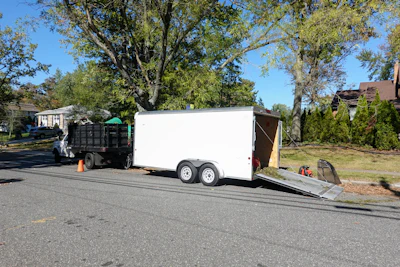
Picture this: Your crew pulls the truck and a loaded trailer to the curb while they work in a backyard. A driver comes down the street, drifts wide and clips the trailer, then tells the responding officer the trailer was jutting into the lane and the truck rolled into him. The truck never moved. Nobody was in it. But, without footage it's one story against another. With footage and GPS showing the truck parked and stationary the whole time, simplifies the same incident.
A Timestamp Ends a Customer Dispute Before It Costs You
Telematics tools settle a quieter problem that lawn care businesses know all too well: Much of the work leaves nothing obvious behind. You put down a pre-emergent or treat for grubs, and a week later the customer looks out at the yard, sees nothing dramatic and decides the crew skipped the visit. Now you're stuck. Dispute the charge and you risk the account and a reputation hit. Let it go, and you eat the cost of work you performed.
GPS arrival and departure records, paired with dashcam video, take that decision off the table. You pull up the timestamp and route history, the visit is confirmed, and the conversation’s over in a few minutes with no chargeback.
That same data solves another headache. Letting a crew member take a truck home is normal in this business, and most of the time it’s no problem at all. The exception is the employee who picks up a private weekend job in your truck. If that job goes sideways and someone gets hurt, the injured party comes after the company listed on the truck. After-hours location records and movement alerts give you a chance to make a phone call and clear things up before you're handed legal papers.
Your Drivers Think They are Safer Than They Really Are
There’s one more payoff, and this one shows up every day your trucks are out: The data helps your crew drive better. The catch is that most drivers already think they’re safer than they are. In the same survey, 73 percent of fleet managers said their drivers overestimate their own safety performance against the telematics data. That’s the problem coaching is meant to solve, but it falls apart without evidence.
Once a driver realizes the camera is usually there to back them up…they start to trust it, use it, even defend it.
A coaching conversation with no data behind it just turns into an argument. The driver says they did nothing wrong, you’ve got nothing that says otherwise, and you both walk away frustrated. Pull up a specific clip from a specific moment, and the whole tone changes. Now you’re not accusing anyone, you’re showing them what happened and asking how to keep it from happening again.
Whether that conversation works at all comes down to how your drivers see the camera in the first place. If they think it’s there to catch them out, they’ll resent it. But once a driver realizes the camera is usually there to back them up, since most of the time they aren’t the one at fault, they start to trust it, use it, even defend it.
A System Nobody Acts on Won't Protect You
Most owners I talk to can tell you what system they're running. Fewer can tell you what it flagged last week. While 91 percent of fleet managers reported using GPS tracking but only 60 percent were putting that data to work for anything beyond accident prevention. That gap between owning the tools and acting on what they show is where most liability exposure quietly builds.
Here’s the part that catches owners off guard: A system left alone can also work against you in court.
Here’s the part that catches owners off guard: A system left alone can also work against you in court. If an incident reaches a judge and it comes out that your data flagged a problem — say, weeks of hard braking or speeding from the same driver — and you never did anything about it, you're worse off than an owner who never had a system. A written safety policy carries the same weakness. On paper it looks responsible, but without records showing you enforced it, it won't hold up when someone challenges it.
Your own Data is Leverage at Renewal
Documentation pays you back here, too. Commercial auto insurance has punished small operators for over a decade. AM Best reports that the commercial auto line has posted underwriting losses for 14 straight years, with claim severity climbing roughly 8 percent a year. Carriers have answered with rate increases that show no sign of letting up, and if you run trucks, you've felt it at renewal.
51% of fleet managers said their business could not financially survive a lawsuit from a driver accident.
Many owners don't realize their own data can have a big impact. Many underwriters read telematics scorecards, documented coaching records and safety program adoption as signs of a well-managed fleet — and those that don’t are catching on. An owner who arrives at renewal with clean driver behavior reports and a history of fixing problems is a different risk on paper than one who brings nothing. A documented safety record is worth more than a clean one you can't prove.
Plenty of fleets running telematics have never handed that data to their insurer, mostly because nobody asked. If you have a system in your trucks, ask your agent a direct question before the next rate review: Can we use our telematics data to support the renewal submission?
Another sobering figure: 51 percent of fleet managers said their business could not financially survive a lawsuit from a driver accident. That's a number that should get your attention. The owners who get taken down by it are rarely the ones who skipped the technology, but the ones who bought it, mounted it and never built the habit of acting on what it showed them.
If telematics is already in your trucks, spend an afternoon making sure the alerts are set, the footage gets reviewed and someone is assigned to look. A system you use is protection, but a system you simply own is just another monthly expense.