Now more than ever, clients want beautiful, environmentally friendly outdoor spaces that don’t require constant upkeep. Whether it’s a homeowner tired of spending time and resources on a water-intensive lawn or a commercial property owner looking for a lasting solution to their site flooding issues, landscaping professionals are being challenged to rethink how outdoor spaces are designed and maintained.
There’s more to this challenge. Tune into any news channel or scroll through the news feed on your phone and it’s nearly impossible to ignore the frequency and intensity of today’s weather events. As weather patterns become more unpredictable, property owners are increasingly looking for landscaping solutions that can perform efficiently in a range of conditions — from better managing stormwater during major rainfall events to conserving water during dry seasons.
LID takes a decentralized, nature-based approach that manages water closer to where it falls.
To help meet this moment, the U.S. Environmental Protection Agency (EPA) recommends the prioritization of Low Impact Development (LID) principles. Rather than collecting runoff in piped or channelized networks and controlling the flow downstream in a large stormwater management facility, LID takes a decentralized, nature-based approach that manages water closer to where it falls.
LID solutions such as permeable pavers and underground water containment systems are reshaping landscaping projects. When used together, these complementary solutions can function as an integrated system that improves water management, supports long-term site performance and addresses evolving environmental concerns. For landscaping professionals, this creates a timely opportunity to address multiple challenges for their clients at once.
 Invisible Structures
Water-intensive Areas & Non-porous Surfaces
To utilize LID solutions effectively, landscape professionals should consider how different surface materials influence water movement. Traditional landscaping surfaces each come with tradeoffs. For example, large grass areas at personal residences, community parks and gardens or commercial properties need regular mowing and watering and are susceptible to rutting and puddles from heavy foot traffic, requiring constant maintenance.
Flexible permeable paving systems offer landscaping professionals a smarter alternative.
Conventional concrete and asphalt also present challenges. Because these impermeable surfaces prevent water from soaking into the ground, rainfall can become runoff that contributes to drainage issues, standing water and soil erosion over time.
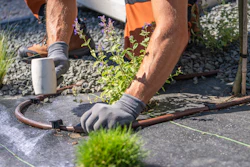
Flexible permeable paving systems offer landscaping professionals a smarter alternative. Flexible permeable paving systems, like plastic porous pavers, feature a grid-like structure that can be filled with grass or gravel. Some plastic porous pavers can deliver up to 92 percent void space to let rainwater seep through the surface and penetrate the ground below. This process mimics natural infiltration to reduce stormwater runoff, which helps stabilize the soil conditions and mitigate the risk of flooding on a property. Because they are strong and durable, plastic porous pavers are ideal for load-bearing outdoor applications like slow-speed driveways, parking lots, fire lanes, walkways and outdoor event spaces. This offers greater flexibility across a wide range of residential and commercial projects.
Once installed, porous paving systems integrate seamlessly into the landscape design. Instead of choosing between a conventional paved outdoor surface and a landscaped area, property owners can achieve the look and feel they want and significantly improve how the ground handles water. Grass-filled porous pavers, for example, can look like a continuous lawn that blends seamlessly with the existing landscape. The paving system is hardly noticeable. Or consider a gravel-filled porous paver to create a textured, natural-looking gravel surface using aggregate that can be selected to blend into the rest of the landscape. The strong grid framework holds everything in place without the common issues of shifting stones or ruts while still allowing water to seep into the ground.
It’s important to underline that in most applications, ongoing maintenance of porous paving systems is limited to routine landscape care or occasional redistribution of gravel in high-traffic areas. This makes them an appealing long-term solution for property owners looking to reduce the cost and time dedicated to ground maintenance.
These plastic porous paver systems should remind landscaping professionals that integrating LID solutions does not mean sacrificing an aesthetically beautiful property — it means creating outdoor spaces that work more like natural systems.
 Invisible Structures
Don’t Overlook What’s Below the Surface
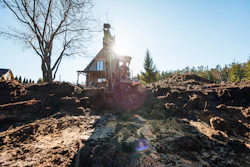
Successful low-maintenance landscapes aren’t defined only by what clients see on the surface. What’s happening below grade can be just as important. Modular, stackable water containment systems provide landscape professionals with an effective way to capture and temporarily store stormwater while allowing the surface area to remain functional. In some cases, it also creates an opportunity for water reuse. These systems can be incorporated into a range of applications, from multifamily properties and commercial developments to municipal parks, athletic fields and outdoor event spaces.
What’s happening below grade can be just as important.
Because these systems are installed underground, they allow landscaping professionals to address site drainage needs without dedicating valuable surface area to visible stormwater infrastructure. Their modular design provides flexibility when it comes to system layouts and depths, making them adaptable to a variety of site conditions. So instead of dedicating above-ground areas to water management features, the site can remain available for planting areas, gathering spaces, recreational uses and other outdoor amenities that clients value (and actually want to look at).
Taking a subsurface approach ultimately gives landscaping professionals another tool to help solve drainage issues that might otherwise limit a site’s potential. Rather than treating stormwater management as a separate project requirement, it can become part of the integrated landscape design that supports long-term performance without compromising the function or aesthetics of the space.
 Invisible Structures
More Efficient Water Management
While valuable on their own, porous paving and underground water containment systems can become even more effective when used together. Rainfall can seep into the ground through a porous paver rather than becoming surface runoff, then move into an underground containment system for temporary storage or potential reuse. Together, these complementary solutions support LID principles by helping manage stormwater close to where it falls while preserving the functionality of outdoor spaces.
For landscape professionals, this integrated approach creates an opportunity to become a trusted partner who helps their clients solve real-world challenges. By offering water-smart solutions, pro landscapers can differentiate their businesses and keep pace with evolving client expectations and environmental challenges.